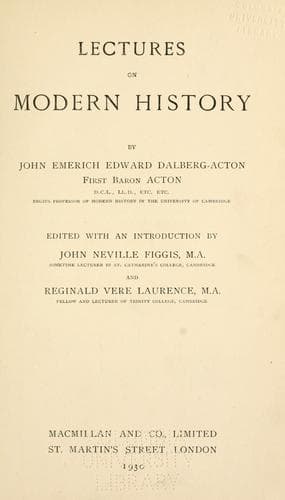
Lectures on Modern historyActon, John Emerich Edward Dalberg Acton, Baron
History
Lectures on Modern history
Acton, John Emerich Edward Dalberg Acton, Baron
History, Modern
The most important result of the stay at the Wartburg was the
translation of the New Testament, which was begun towards the end of
the year, and was completed in about three months. There were already
eighteen German Bibles, and he knew some of them, for a particular
blunder is copied from an edition of 1466. All those that I have
seen, and I have seen nearly all in Dr. Ginsburg's collection, are
unwieldy folios. Luther's translation was published at a florin and a
half, and may now be had for sixty guineas. It was reprinted
eighty-five times in eleven years. The text as we know it was revised
by his friends twenty years later. It was his appeal to the masses,
and removed the controversy from the Church and the school to the
market-place. The language had to be modified for the people of the
South, and almost rewritten for the North; but it ended by impressing
central German as the normal type for the whole country. It was the
first translation from the Greek, and it was the work of the greatest
master of German.
During the eclipse at the Wartburg Leo X was succeeded by Adrian of
Utrecht, the Regent of Spain, a man of learning and devout life, who
proceeded to reverse his predecessor's policy. He addressed a Brief
to the Diet at Nuremberg, saying that of all those in authority at
Rome none were without reproach, and the evils from which the Church
was suffering had been caused and propagated by the papal court. To
this memorable exhibition of integrity his envoy added that Luther
deserved to be idolised if he had been content with the exposure of
abuses, and that the real offender was Leo X. This change of front
removed the charge from the outer branch to the centre. Luther had
been hitting the wrong man. It was now avowed that the transgressor
was not an obscure itinerant, but the sovereign pontiff himself, and
that Luther's adversaries were in the wrong. Adrian had been Grand
Inquisitor in four kingdoms, and he moderated expectation by inviting
the Germans to be worthy of the illustrious example set by their
ancestors, who burnt John Hus and Jerome of Prague. Therefore
Erasmus, when summoned to Rome to advise with him, declined to
come. "If they were going to shed blood," he said, "he would not be
wanted."
Public-domain text, read in full here on John Shaqi.
Reviews
Reviews
No reviews yet
Be the first to share your thoughts on this work.
Elsewhere in the archive
Join the Discussion
Join the discussion
Sign in to leave a comment or review.
Sign InorCreate an account