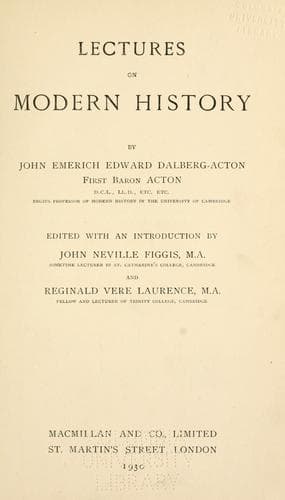
Lectures on Modern historyActon, John Emerich Edward Dalberg Acton, Baron
History
Lectures on Modern history
Acton, John Emerich Edward Dalberg Acton, Baron
History, Modern
When the Holy Office for the universal Church was set up in Rome in
1542, it was in many respects distinct both from the first medieval
type and from the later Spanish type. In the Middle Ages the
headquarters were in the south of France, and the legislation was
carried out by Councils at Toulouse, Narbonne, and Beziers. The
Popes controlled them through their legates, and issued their own
orders to the Dominicans. But it was not one of the institutions of
the Court of Rome, and did not always act in harmony with it. It now
became part of the Roman machinery and an element of centralisation.
A supreme body of cardinals governed it with the Pope at their head.
The medieval theory was that the Church condemned, and the State
executed, priests having nothing to do with punishment, and requesting
that it might not be excessive. This distinction fell away, and the
clergy had to conquer their horror of bloodshed. The delinquent was
tried by the Pope as ruler of the Church, and burnt by the Pope as
ruler of the State. Consequently, this is the genuine and official
Inquisition, not that of the Middle Ages, which was only partly in the
hands of Rome; not that of Spain, which was founded but not governed
by Rome, and for the developments of which the Papacy is not directly
responsible.
Originally the business of the Inquisitor was to exterminate. The
Albigenses delighted in death, and they were disappointed when it was
put off. But now it was directed against opinions not very clearly
understood or firmly held, that often resembled a reformed Catholicism
more than Protestantism. The number of victims was smaller. At
Venice, where the Holy Office had a branch, there were 1562 trials in
the sixteenth century, 1469 in the seventeenth, 541 in the eighteenth.
But executions were frequent only in Rome. There, in many recorded
cases, the victim was strangled before burning. It is doubtful
whether death by fire was adopted as the most cruel; for boiling had
been tried at Utrecht, and the sight was so awful that the bishop who
was present stopped the proceedings. Roman experts regard it as a
distinctive mark of the new tribunal that it allowed culprits who
could not be caught and punished in the proper way, to be killed
without ceremony by anybody who met them. This practice was not
unprecedented, but it had fallen into disuse with the rest during the
profane Renaissance, and its revival was a portentous event, for it
prompted the frequent murders and massacres which stain the story of
the Counter-Reformation with crimes committed for the love of God. The
laws have not been repealed, but the system continued in its force for
no more than a century; and before the death of Urban VIII the fires
of Rome were quenched. At that time persecution unto death was not
extinct in England; the last instance in France was in 1762, and in
Spain still later. The immediate objects were obtained in the first
thirty years.
Public-domain text, read in full here on John Shaqi.
Reviews
Reviews
No reviews yet
Be the first to share your thoughts on this work.
Elsewhere in the archive
Join the Discussion
Join the discussion
Sign in to leave a comment or review.
Sign InorCreate an account