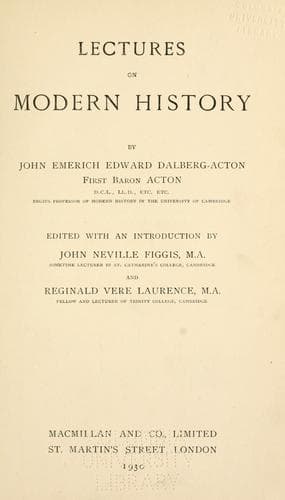
Lectures on Modern historyActon, John Emerich Edward Dalberg Acton, Baron
History
Lectures on Modern history
Acton, John Emerich Edward Dalberg Acton, Baron
History, Modern
St. Ignatius directed his disciples according to the maxim that more
prudence and less piety is better than more piety and less prudence.
His main desire was that they should always act together, presenting a
united front, without a rift or a variation. He suppressed
independence of mind, discouraged original thinking and unrestrained
research, recommended commonly accepted opinions, and required all to
hold without question the theology of St. Thomas. The training he
imposed made ordinary men very much alike. And this is the mistake we
have to guard against in considering the Jesuits. The intended unity
never was enforced when the order became numerous and was joined by
many able men. There arose so great a wealth of talent that it was
followed by variety in ideas among them, such as the founder never
contemplated. Their general, Aquaviva, forbade every opinion that
contradicts St. Thomas. There could be no question whether it was
true or false, and no other test of truth than conformity with his
teaching. Yet Molina taught, in regard to grace, a doctrine very
different from Thomism, and was followed by the bulk of his order.
They were expected to think well of their rule and their rulers; but
the most perspicacious exposure of what he called the infirmities of
the company was composed by Mariana. Jesuits were by profession
advocates of submission to authority; but the Jesuit Sarasa preceded
Butler in proclaiming the infallibility of conscience. No other
Society was so remarkable for internal discipline; but there were
glaring exceptions. Caussin, confessor to Lewis XIII, opposed the
policy of his superiors, and was dismissed by them. And when the
general required works on theology to be revised at Rome, before
publication, he was told that Father Gretser of Ingolstadt would never
consent. They were all absorbed in the conflict with the Protestants;
but when the idea of reunion arose, late in the seventeenth century,
there were Jesuits, such as Masenius, one of those who anticipated
Paradise Lost, who wrote in favour of it.
Public-domain text, read in full here on John Shaqi.
Reviews
Reviews
No reviews yet
Be the first to share your thoughts on this work.
Elsewhere in the archive
Join the Discussion
Join the discussion
Sign in to leave a comment or review.
Sign InorCreate an account