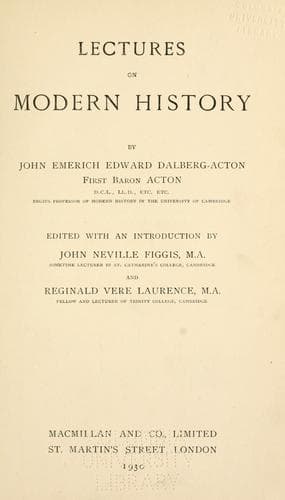
Lectures on Modern historyActon, John Emerich Edward Dalberg Acton, Baron
History
Lectures on Modern history
Acton, John Emerich Edward Dalberg Acton, Baron
History, Modern
Here at last the Catholics acquired a leader who was a man of original
genius, and who grasped the whole, or nearly the whole, situation.
The Papacy had let things go to ruin; he undertook to save the Church
through the Papacy. The ship, tossed in a hurricane, could only be
rescued by absolute obedience to the word of command. He called his
order the Company of Jesus, making it the perpetual militia of the
Holy See for the restoration of authority; and he governed it not only
with military discipline, but with a system of supervision and
counter-checks which are his chief discovery. The worst crime of the
Jesuits, says Helvetius, was the excellence of their government.
Nothing had done more to aid the Reformation than the decline and
insufficiency of the secular clergy. By raising up a body of
virtuous, educated, and active priests, the Jesuits met that argument.
The theological difference remained, and they dealt with it through
the best controversialists. And when their polemics failed, they
strove, as pamphleteers, and as the confessors of the great, to resist
the Protestants with the arm of the flesh. For the multitudes that
had never heard the Catholic case stated, they trained the most
eloquent school of modern preachers. For security in the coming
generation, they established successful colleges, chiefly for the
study of good silver Latin, and they frequented the towns more than
the country, and the rich more than the poor. Thus, while they
pursued their original purpose as missionaries to the heathen, almost
civilising South America, and almost converting China, they kept their
forces gathered for the repulse of Protestantism. They so identified
their order and the Church itself with the struggle for existence in
Europe, that they were full of the same spirit long after the
Counter-Reformation was spent and the permanent line of frontier laid
down in the Thirty Years' War, and were busy with the same policy down
to the Revocation and the suppression of Port Royal in France, and
longer still in Poland.
Public-domain text, read in full here on John Shaqi.
Reviews
Reviews
No reviews yet
Be the first to share your thoughts on this work.
Elsewhere in the archive
Join the Discussion
Join the discussion
Sign in to leave a comment or review.
Sign InorCreate an account