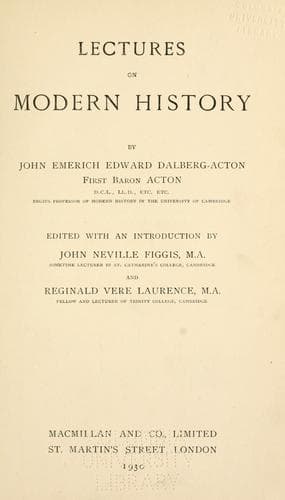
Lectures on Modern historyActon, John Emerich Edward Dalberg Acton, Baron
History
Lectures on Modern history
Acton, John Emerich Edward Dalberg Acton, Baron
History, Modern
A more persuasive means of expressing opposition was money. When a
divine appeared at Trent, the legates, or Visconti, the agent of the
Cardinal nephew, decided whether he was to receive payment for his
prospective services. Even the Cardinal of Lorraine, the head of the
Gallican party, and one of the first men in Europe, gave way for a
considerable sum. Father Paul, in a very famous work, describes the
Council as a scene of intrigue in which the good intentions of
virtuous prelates were thwarted by the artifices of Rome. If the bulk
of virtuous prelates resembled Pole and Lorraine, we cannot say much
for the strength of their good intentions. Some remedies were,
however, applied, and the state of the clergy was improved. On the
whole, the reforms were regarded by the government as a disappointing
result of so much promise and so much effort.
The Council instituted the index of prohibited books, which is the
fourth article in the machinery of resistance. At first, the new
power of the press was treated with large indulgence. This was
changed by the Reformation, and far more by the organised reaction
against it. Books were suppressed by the State, by the clergy, and by
the universities. In 1531 the Bishop of London prohibited thirty
books at St. Paul's Cross, as well as all other suspect works
existing, and to be hereafter written. Vienna, Paris, Venice,
followed the example. In 1551, certain books enumerated by the
university of Louvain were forbidden by Charles V under pain of death.
A German divine warned the Pope that if the fathers of Trent were
allowed to read Lutheran books they would become Lutherans themselves,
and such writings were accordingly forbidden even to cardinals and
archbishops. The idea of drawing up a comprehensive list of all that
no man should read commended itself to the zeal of Caraffa, having
been suggested to him by Della Casa, who had published such a list at
Venice. He issued the first Roman index, which, under his successor,
who was not his friend, was denounced at the Council of Trent as a bad
piece of work, and became so rare that I have never seen a copy. It
was proposed that a revised edition should be prepared, and in spite
of protests from those who had assisted the late Pontiff, and of the
Spaniards, who saw the province of their Inquisition invaded, the
thing was done, and what was called the Tridentine Index appeared at
Rome in 1564. It alludes only in one place to the work which it
superseded. A congregation was appointed to examine new publications,
to issue decrees against them as required, and to make out catalogues
from time to time of works so condemned. Besides this, censures were
also pronounced by the Pope himself, the Inquisition, the Master of
the Sacred Palace, and the Secretary of the Index, separately. In
this way an attempt was made to control what people read, committing
to oblivion works of Protestant scholars, and of such men as
Public-domain text, read in full here on John Shaqi.
Reviews
Reviews
No reviews yet
Be the first to share your thoughts on this work.
Elsewhere in the archive
Join the Discussion
Join the discussion
Sign in to leave a comment or review.
Sign InorCreate an account