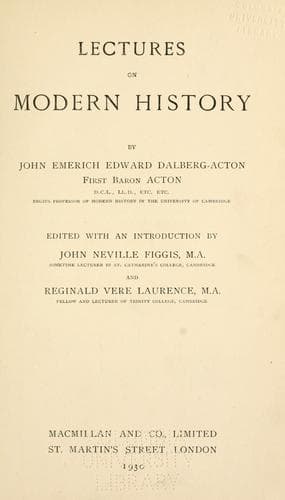
Lectures on Modern historyActon, John Emerich Edward Dalberg Acton, Baron
History
Lectures on Modern history
Acton, John Emerich Edward Dalberg Acton, Baron
History, Modern
Machiavelli, and correcting offensive texts, especially historians.
Several such corrected editions were published at the time, and many
things were reprinted with large omissions. But no Index
Expurgatorius, no notification of what called for modification, was
ever published by Rome, officially; and when we use the term, we are
thinking of Spain, where it grew into a custom. The best way to
suppress a book is to burn it, and there were, accordingly, frequent
bonfires of peccant literature. One man, Konias, is said to have thus
destroyed 60,000 books, principally Bohemian. Freedom of speech and
sincerity of history were abolished for many years.
In connection with this repressive policy, and as its counterpart, a
scheme ripened to place Rome, with its libraries, its archives, its
incomparable opportunities of gathering contributory aid from every
quarter of the Church, at the head of ecclesiastical literature. The
Calendar was reformed. The text of the Canon Law was corrected. The
Latin Vulgate was revised by Pope Sixtus himself, and every further
attempt to improve it was energetically put down. Collections of
councils and editions of Fathers were projected, and Baronius, of the
Oratory, began the greatest history of the Church ever written, and
carried it down to the eleventh folio volume.
In this manner the foundations were laid of that later scholarship,
that matured and completed Renaissance, by which the Catholics
recovered much of the intellectual influence that had passed to other
hands, and learning assisted policy in undoing the work of the
reformers.
Public-domain text, read in full here on John Shaqi.
Reviews
Reviews
No reviews yet
Be the first to share your thoughts on this work.
Elsewhere in the archive
Join the Discussion
Join the discussion
Sign in to leave a comment or review.
Sign InorCreate an account