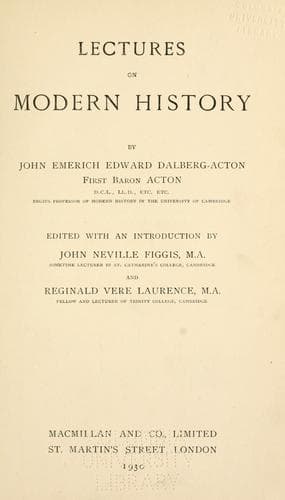
Lectures on Modern historyActon, John Emerich Edward Dalberg Acton, Baron
History
Lectures on Modern history
Acton, John Emerich Edward Dalberg Acton, Baron
History, Modern
The natural and inevitable centre of the movement which is known as
the Catholic Reformation, but which, for reasons already indicated, is
better called the Counter-Reformation, was Rome. It was an enterprise
requiring consistency in the objects aimed at, variety in the means,
combination with the Powers and avoidance of rivalry, an authority
superior to national obstacles and political limitations. At first
the initiative did not reside with the Papacy. Farnese, in whose
pontificate the transition occurred from the religion of Erasmus to
the religion of Loyola, allowed men to act for him whose spirit
differed from his own. He long put off the Portuguese demand for a
tribunal like the Inquisition of Castile, on the ground that it was a
mere scheme of spoliation. With the elevation of Cervini in 1555,
reforming or Tridentine Catholicism ascended the papal throne; but he
died before his virtues or his talents could avail. Caraffa himself
followed. He let the Council drop, saying that no such thing was
needed, if governments did their duty. By his lack of control, he
pushed things to a breach with the moderate party at home, and with
the Habsburgs abroad, and the Roman people threw his statue into the
Tiber, in their rejoicings when he died, and released seventy
prisoners that he kept in the Inquisition. His nephews, who
compromised him and had incurred disgrace in his lifetime, were put to
death by his successor. They were the last papal nephews of the old
type, angling for principalities and using the Papacy for their own
ends. Pius IV, when he closed the Council, strove to do its work by
reforms at home. Three modern saints dominated in his time, and
effected a conspicuous change in the aspect of Rome. His nephew was
Charles Borromeo. St. Philip Neri was the best-known and the
best-loved figure in the streets of the city, and Alexandrino governed
the Inquisition as an almost independent power. He succeeded, as Pius
V, and then the Counter-Reformation was master. Pius was the most
austere, the most ardent, the most vehement of men. He incited France
to civil war, applauded the methods of Alva, deposed Elizabeth, and by
incessant executions strove to maintain public decency and orthodox
religion. Protestantism disappeared from Italy in his day, as it had
already done in Spain. The Counter-Reformation touched high-water
mark with the massacre of St. Bartholomew, a few months after his
death.
The quarter of a century from 1564 to the death of Sixtus V in 1590 is
the active period of the movement. It begins when the Council, having
determined doctrine, dispersed; and it declines when, by the death of
Mary Stuart and the flight of the Armada, the Protestant succession
was secured in England and Scotland, and the churches acquired their
permanent limit.
Public-domain text, read in full here on John Shaqi.
Reviews
Reviews
No reviews yet
Be the first to share your thoughts on this work.
Elsewhere in the archive
Join the Discussion
Join the discussion
Sign in to leave a comment or review.
Sign InorCreate an account