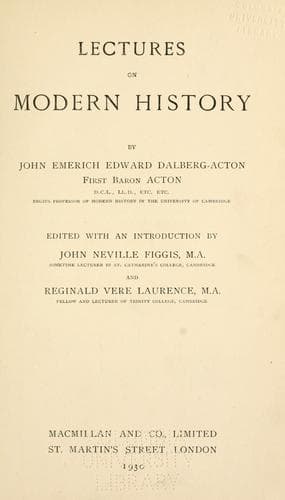
Lectures on Modern historyActon, John Emerich Edward Dalberg Acton, Baron
History
Lectures on Modern history
Acton, John Emerich Edward Dalberg Acton, Baron
History, Modern
These enactments were an immense advance, practically, but they did
not involve the liberty of conscience. The absolute right of the
State to determine the religion it professed was not disputed, but it
was tempered by the right of emigration. No man could be compelled to
change, but he might be compelled to go. State absolutism was
unlimited over all who chose to keep their home within the precincts.
There was no progress in point of principle. The Christian might have
to depart, while the Jew remained. No Protestant could complain if he
was expelled from Cologne; no Catholic if he could not have his
domicile at Leipzig. The intolerance and fierceness of the Germans
found relief in the wholesale burning of witches.
Charles V would have nothing to do with these innovations. He left it
all to his brother Ferdinand, King of Bohemia and Hungary, who was
more elastic and pliable than himself. With the Turk over the border,
he could not exist without the goodwill of both parties; and he
desired the vote of Lutheran electors to make him emperor. He had no
Inquisition in one part of his dominions contradicting and condemning
toleration in the rest. He was an earnest promoter of reform in the
shape of concession. The embers of Hussitism were not extinct in the
region of which Bohemia was the centre. Ferdinand had that as well as
Lutheranism to contend with, and he desired to avert peril by allowing
priests to marry and laymen to receive the cup. That is to say, he
desired to surrender the two points for which the Church had struggled
successfully against the State in the eleventh century, against the
Bohemians in the fifteenth. His conciliatory policy was assisted by
the moderation of the Archbishop of Mentz. At Rome they said that the
empire was divided between Christ and the devil. But the Pope,
advised by Jesuits, made no protest.
Public-domain text, read in full here on John Shaqi.
Reviews
Reviews
No reviews yet
Be the first to share your thoughts on this work.
Elsewhere in the archive
Join the Discussion
Join the discussion
Sign in to leave a comment or review.
Sign InorCreate an account