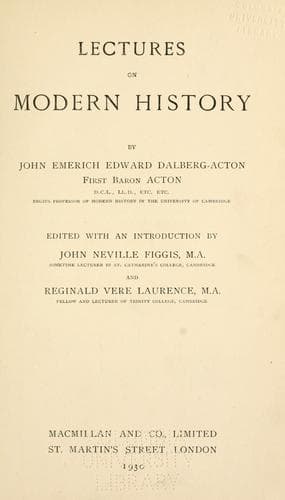
Lectures on Modern historyActon, John Emerich Edward Dalberg Acton, Baron
History
Lectures on Modern history
Acton, John Emerich Edward Dalberg Acton, Baron
History, Modern
Ferdinand had so regulated things in his brother's interest, that the
measure did not include the Netherlands. The laws which afterwards
produced the revolt were not invalid by the Peace of Religion, and the
victims of Alva had no right to appeal to it. Charles V did not
choose to surrender that which alone gave unity to his complicated
empire. The German princes were allowed to have subjects of one
religion only. That prerogative was denied to the Emperor. The
imperial dignity, in its ideal character as the appointed defender and
advocate of the universal Church, existed no longer. A monarch
reigning over Catholic and Protestant alike was an inferior
representative of unity and authority, and a poor copy of Charlemagne.
There was no obvious reason for his existence. It was an intolerable
hypocrisy to be the friend of Protestants where they were too strong,
and to burn them where they were weak. The work of his life was
undone. In more than thirty years of effort he had neither reconciled
the Protestants nor reformed the Church. The settlement of the
Reformation was an acknowledgment of defeat, and the result of his
career was that religious division had become the law of his empire.
Therefore, when the Peace of Religion was concluded, Charles V laid
down the sceptre. The new empire, based on religious equality, he
gave to his brother. It was only by detaching it from his hereditary
dominions that he could reconstruct what had crumbled to pieces in his
hands. Then he rebuilt the great conservative and Catholic monarchy
for his son, assigning to him Spain, Naples, Milan, the Netherlands,
the Indies, England, and the supreme protectorate of Rome. The mixed
possessions went to Ferdinand. The boundless empire, based on the
principle of unity, and the championship of the Catholic Church all
the world over, was for Philip II. All that was his, to keep or to
resign. All that he chose to resign. For with his prodigious good
fortune, his inheritance of greatness, his unexampled experience of
complex affairs, his opportunities for having at his elbow the best
talent in the world, his admirably prudent and moderate temper,
Charles V broke down over the problem of the Reformation, as we shall
see that the Counter-Reformation was fatal to his son. And it was in
this way that Philip found the lines of his policy laid down for him,
before he assumed the crown of Spain, by the conditions under which
his father abdicated. The ancient function of the empire passed to
him, and the purpose of his vast dominion, the intelligible reason of
its apparition among the nations, was to accomplish that in which,
under his more gifted father, imperial Germany had failed.
Public-domain text, read in full here on John Shaqi.
Reviews
Reviews
No reviews yet
Be the first to share your thoughts on this work.
Elsewhere in the archive
Join the Discussion
Join the discussion
Sign in to leave a comment or review.
Sign InorCreate an account