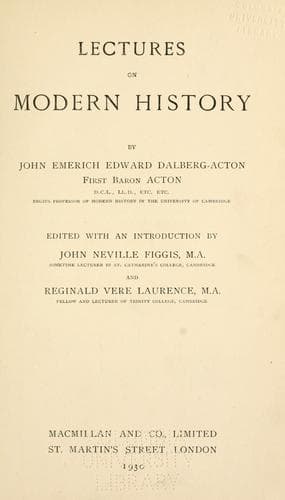
Lectures on Modern historyActon, John Emerich Edward Dalberg Acton, Baron
History
Lectures on Modern history
Acton, John Emerich Edward Dalberg Acton, Baron
History, Modern
At the time when persecution suddenly began to rage in France John
Calvin escaped to Strasburg, and there composed his Institute, the
finest work of Reformation literature. He wrote with a view to show
that there was nothing in the Protestant religion to alarm the
government, and that the change it demanded was in the Church, not in
the State. He dealt more largely with theology than with practical
religion, and did not disclose those ideas on the government of
religious society that have made him the equal of Luther in History.
Geneva, when he came there in 1536, was a small walled town of less
than 20,000 inhabitants, with so narrow a territory that France was
within cannon range on one side and Savoy on the other. It was secure
in the alliance and protection of Berne, which came almost to the
gates; for what is now the canton of Vaud was, until the French
Revolution, a Bernese dependency. It had been an episcopal city, but
the bishop had retired to Annecy, and the Genevese Reformation had
been at the same time a Genevese Revolution. Power over Church and
State passed to the commonwealth, to the municipality. The new
masters, rejoicing in their independence, did not at once settle down;
the place was disturbed by factions, and was not a scene of
edification.
Calvin set to work to reform the community, to introduce public order
and domestic virtue. He was a foreigner by birth, and not
conciliatory in disposition; and after a brief experiment, the
offended Genevese cast him out. He was not yet thirty. He returned
to Strasburg and rewrote his Institute, expounding his theocratic
theory of the government of the Church by the Church, and of the State
by the union of Church and State. He was present at the Diet of
Ratisbon, and saw the Lutherans in a yielding mood, when Melanchthon
and Contarini, with the urgent mediator Gropper of Cologne, were very
near understanding each other. That event, as everybody knows, did
not come off; but everybody does not know the consequences, for we
shall see that the Counter-Reformation sprang from those conferences
at Ratisbon. Calvin had no part in Irenics. He was persuaded that
the work before them was to create not a new church, but a new world,
to remodel not doctrine only, but society; that the chasm could never
be bridged, but must grow wider with time. That conviction was not
yet strongly held by the German Lutherans, and they do not all hold it
at the present day. During his absence Cardinal Sadolet wrote to the
Genevese, intreating them not to break up the unity of Latin
Christendom; for Geneva was the first town beyond the Teutonic
range that went over. Sadolet was not only reputed the finest
Latinist of the age, but he was the most gracious of the Roman
prelates, a friend of Erasmus, an admirer of Contarini, and the author
of a commentary on St. Paul in which Lutheran justification was
suspected. The Genevese were not then so rich in literature as they
Public-domain text, read in full here on John Shaqi.
Reviews
Reviews
No reviews yet
Be the first to share your thoughts on this work.
Elsewhere in the archive
Join the Discussion
Join the discussion
Sign in to leave a comment or review.
Sign InorCreate an account