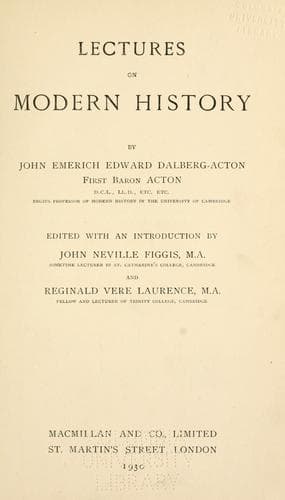
Lectures on Modern historyActon, John Emerich Edward Dalberg Acton, Baron
History
Lectures on Modern history
Acton, John Emerich Edward Dalberg Acton, Baron
History, Modern
afterwards became, and they were not prepared to answer the challenge,
when Calvin did it for them. In 1541, after a change of government,
he was recalled. He came back on condition that his plans for the
Church were accepted, and his position remained unshaken until his
death.
The Strasburg clergy, in losing him, wrote that he was unsurpassed
among men, and the Genevese felt his superiority and put him on the
commission which revised the Constitution. It was not changed in any
important way, and the influence of the Geneva Constitution upon
Calvin was greater than his influence on the government of Geneva.
The city was governed by a Lesser or Inner Council of twenty-five,
composed of the four syndics, the four of last year, and as many more
as made up the twenty-five. These belonged to the ruling families,
and were seldom renewed. Whilst the Lesser Council administered,
through the syndics, the Great Council of two hundred was the
legislature. Its members were appointed, not by popular election, but
by the Lesser Council. Between the twenty-five and the two hundred
were the sixty, who only appeared when the Lesser Council wanted to
prepare a majority in the Greater Council. Its function was to
mediate between the executive and the legislature. It was a system of
concentric circles; for the twenty-five became the sixty by adding the
necessary number of thirty-five, and the sixty became the two hundred
by the addition of one hundred and forty members. Beyond this was the
assembly of citizens, who only met twice a year to elect the syndics
and the judge, from names presented by the Lesser Council. The
popular element was excluded. Beyond the citizens were the burghers,
who did not enjoy the franchise. Between the two there was material
for friction and a constitutional struggle, the struggle from which
Rousseau proceeded, and which had some share in preparing the French
Revolution.
Public-domain text, read in full here on John Shaqi.
Reviews
Reviews
No reviews yet
Be the first to share your thoughts on this work.
Elsewhere in the archive
Join the Discussion
Join the discussion
Sign in to leave a comment or review.
Sign InorCreate an account