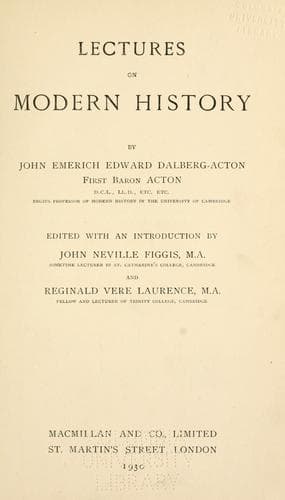
Lectures on Modern historyActon, John Emerich Edward Dalberg Acton, Baron
History
Lectures on Modern history
Acton, John Emerich Edward Dalberg Acton, Baron
History, Modern
When these negotiations commenced, in the spring and summer of 1527,
Rome had been sacked by the Imperialists, and Clement was a prisoner
in St. Angelo, or a fugitive at Orvieto, with the strongest motive
for resentment against the author of his humiliation. By the summer
of 1528, when Lautrec was in Italy at the head of a French army,
Clement had conceded virtually the whole of the English demands. He
removed every impediment to the marriage with Anne other than the fact
that Henry was married already. He authorised the trial of the case
in England by Wolsey and Warham; or again, by Wolsey and Campeggio,
Archbishop of Bologna, the best jurist of the sacred college. He
pronounced on the question of law, leaving questions of fact to the
legates, and he pronounced against the terms of the dispensation,
intimating that Julius had done what no Pope has a right to do. He
promised that judgment as given in England would be final, and that he
would not remove the cause to Rome. He was willing that Richmond, the
king's son, should marry the king's daughter, Mary Tudor. He did not
turn a deaf ear even to the proposal of bigamy. For several years he
continued to suggest that Henry should marry Anne Boleyn and renounce
the quest of a divorce. In 1530, somebody informed him that this
would not do, and that brought him to the last of his resources. He
proposed to the Imperialists, in order to prevent a schism, that Henry
should live with Anne without marriage and without divorce. That he
might not be hopelessly wrong with the Emperor, he required that the
most compromising of these documents should be kept secret. His
friendliness rose with the French advance and fell with the French
disasters. If Lautrec would approach the vicinity of Rome, he said,
he would do more, because the Emperor would excuse him on the ground
of compulsion. When Campeggio reached England, Lautrec was dead and
his army defeated. The papal secretary wrote, "Decide nothing, for
the Emperor is victorious, and we cannot afford to provoke him." There
was nothing more to be done.
While the Court was sitting in London, the Pope made his peace with
Charles; Catharine appealed to him from his legates in England, and he
was obliged to call the case before him. The queen's friends demanded
the strongest measures, and Aleander wrote that if you resisted Henry
VIII he became as gentle as a lamb. Such persuasions did not
influence the Pope, who put off action as long as he could, knowing
that a breach would inevitably follow. The French Chancellor warned
him that he would be known to be acting under pressure of the Emperor,
that the censure of Henry would be resented as the victory of Charles.
The French defeat in Italy was the ruin of Wolsey, who had caused the
breach with Spain without any advantage. A year later, when Campeggio
prorogued the Legatine Court, and the divorce had to be given up, he
was dismissed.
Public-domain text, read in full here on John Shaqi.
Reviews
Reviews
No reviews yet
Be the first to share your thoughts on this work.
Elsewhere in the archive
Join the Discussion
Join the discussion
Sign in to leave a comment or review.
Sign InorCreate an account