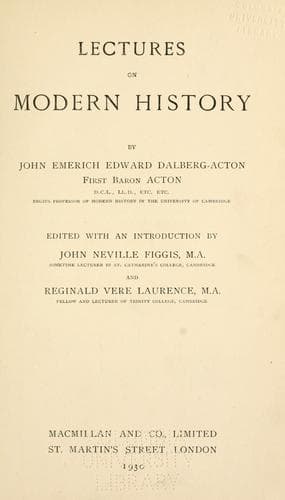
Lectures on Modern historyActon, John Emerich Edward Dalberg Acton, Baron
History
Lectures on Modern history
Acton, John Emerich Edward Dalberg Acton, Baron
History, Modern
One further step had to be taken before settling the matter in
England. By advice of a Cambridge Don the universities were
consulted. They gave various replies, but those that helped the king
were not convincing, for they cost him more than L100,000 and he
obliged the clergy to give him that sum. As it was obvious for what
purpose Henry was arming himself with these opinions, Charles V
conceived serious scruples, and thought for a moment that to give way
might be the lesser evil. At the same time he sent 450,000 ducats to
Rome to facilitate matters; for the divorce was the one pending
question which delayed the conclusion of that treaty of Barcelona
which laid Italy for centuries at the feet of Spain. The uncertainty
in the policy of Rome as the power of the Emperor rose and fell, the
open avowal that so much depended on political considerations, besides
the strange proposal in respect of two wives, led to a belief in
England that the cause was lost by the pressure of interest and fear,
not by principle. Therefore, the establishment of the Spanish
dominion over Italy was quickly followed by the rejection of papal
supremacy in favour of the English state. The bishops themselves were
impressed with the danger of allowing the spiritual power to be
influenced through the temporal power by an enemy of this country, so
that they made no resistance. England broke with the Papacy on these,
and not on strictly religious grounds.
Tunstall, coming up to attend Parliament, suffered himself to be
stopped by a letter from the king, dispensing with his presence.
Fisher alone offered opposition. He caused the royal supremacy to be
accepted with the proviso, "so far as the divine law permits." And as
this proved only a stepping-stone to the unconditional headship of the
Church, he regarded it as his own fault. He refused submission, and
put himself in communication with the Imperialists with a view to
effective intervention. Sir Thomas More, the most modern and original
mind among the men of his time, showed greater caution. He admitted
the right of Parliament to determine the succession, and made no
struggle for Mary Tudor, as he had made none for her mother. He did
not openly contest the royal supremacy until after sentence. Besides
these two, a large number of monks were executed during Cromwell's
ministry.
Public-domain text, read in full here on John Shaqi.
Reviews
Reviews
No reviews yet
Be the first to share your thoughts on this work.
Elsewhere in the archive
Join the Discussion
Join the discussion
Sign in to leave a comment or review.
Sign InorCreate an account