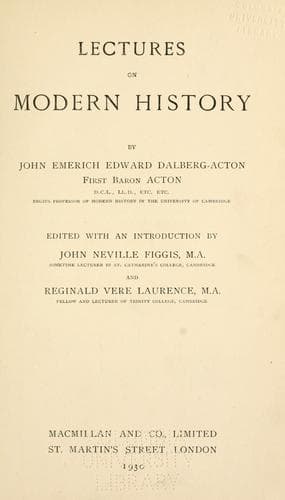
Lectures on Modern historyActon, John Emerich Edward Dalberg Acton, Baron
History
Lectures on Modern history
Acton, John Emerich Edward Dalberg Acton, Baron
History, Modern
The third war of religion, the war of 1569, in which the Huguenots
were defeated in the historic battles of Jarnac and Moncontour, had
been so devastating that the government lost the disposition to go on
fighting, and counsels of moderation prevailed. Coligny, summoned to
advise, was listened to with attention, and a marriage was decided on
between the king's sister, Margaret of Valois, and Henry of Bourbon,
the young King of Navarre, whose birthright made him the head of
the Protestant interest. Before the wedding was celebrated a change
occurred in the European situation which profoundly affected the
policy of France. The revolt broke out in the Netherlands, the real
revolt, which was not the work of Belgian nobles, but of the Water
Beggars, who took advantage of the maritime configuration, and
accomplished the deliverance of the northern provinces.
This was Coligny's opportunity. It was the manifest policy of France
to intervene, now that the conflict was a serious one, and to rectify
the frontier along the line of peril, by which the capital was exposed
to attack. What could not have been attempted while Alva held the
provinces in subjection, was possible now that his power was shaken to
its foundation. England was an obstacle, because England preferred
Spanish masters in the Low Countries to French; but it was possible to
negotiate compensation with Elizabeth; and Charles IX, under pressure
from Coligny, concluded a treaty with her. He also decided that a
Protestant force should join the Flemish insurgents in their
operations against the Duke of Alva. If they succeeded, their success
was to be followed up, and the merit of the expected conquest would be
theirs. Conciliation and peace at home would be purchased by
victories over the Spaniard. If they failed, they would be disavowed.
Accordingly, in July 1572, an expedition under Genlis went to the
relief of Mons, and was betrayed and defeated. The Huguenots had had
their opportunity and had made nothing of it. The perfidy of the
French government was detected, and the king, in his embarrassment,
denounced the invaders, and urged Alva to make short work with
prisoners. At the same time, he did not give up the scheme that had
begun so badly, the scheme for the conquest of Flanders by a forlorn
hope of Huguenots.
Public-domain text, read in full here on John Shaqi.
Reviews
Reviews
No reviews yet
Be the first to share your thoughts on this work.
Elsewhere in the archive
Join the Discussion
Join the discussion
Sign in to leave a comment or review.
Sign InorCreate an account