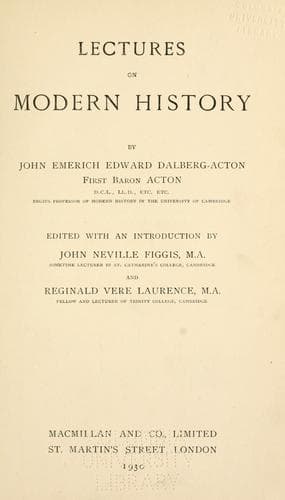
Lectures on Modern historyActon, John Emerich Edward Dalberg Acton, Baron
History
Lectures on Modern history
Acton, John Emerich Edward Dalberg Acton, Baron
History, Modern
princes of the blood among them, and even crowned heads, resistance to
the authority of the day was not felt to be seditious. In this way it
came to pass that while Calvin at Geneva was preaching non-resistance,
Calvinists in France formed an armed opposition and became involved in
plots.
As the new king was too young to govern, Queen Catharine, his mother,
became nominal regent; but as he was married to Mary Stuart, her
uncles governed the kingdom. One of them was the Duke of Guise, the
conqueror of Calais, and the most popular soldier in France. His
brother, the Cardinal of Lorraine, one of the most conspicuous
ecclesiastics of the age, was a Gallican prelate, obnoxious to Rome,
and willing to concede much in favour of the Confession of Augsburg as
an arm against Geneva, maintaining his power by every means, and an
avowed and unshrinking advocate of assassination. Against the
administration of these men, princes and Protestants combined. Their
plans were detected; many accomplices were put to death at Amboise,
and the Prince of Conde was arrested, tried, and in imminent danger of
execution, when Francis II died, and the reign of the Guises was at an
end.
Catharine, whose effective regency now began in the name of Charles
IX, her second son, rested on the moderates. There was so little
passion in her religion that people doubted whether there was much
conviction. When Pius V proffered advice as to the king's marriage,
she replied that he was old enough to act for himself, without foreign
interference. She assured Elizabeth that she would have no objection
if she treated her Catholics as Protestants were treated in France on
St. Bartholomew's day. Once, on the report of a Protestant victory,
she declared that she was quite ready to say her prayers in French.
In Italy, her want of zeal made people suppose that she was at heart a
Huguenot. She encouraged the liberal and conciliatory legislation of
L'Hopital; for the most striking feature of the time is the sudden
outbreak of tolerant opinion.
To arrest this surrender of Counter-Reformation policy, and the ruin
which it portended to the Church in France, Guise fell upon a
congregation of Protestants, and mingled their blood with their
sacrifices. This is the massacre of Vassy, which provoked the wars of
religion. They lasted, with intervals, sometimes of several years,
for a whole generation, and effaced the country as a European Power.
This long obliteration protracted the struggle in the Netherlands, led
to the fall of Mary Stuart, and assisted the triumphant rise and
growth of England in the middle years of Elizabeth. During the
sixties Coligny advanced steadily to the highest place in his party
and in the State, and he repeatedly secured terms which satisfied the
Protestant leaders, though at the expense of their followers.
Public-domain text, read in full here on John Shaqi.
Reviews
Reviews
No reviews yet
Be the first to share your thoughts on this work.
Elsewhere in the archive
Join the Discussion
Join the discussion
Sign in to leave a comment or review.
Sign InorCreate an account