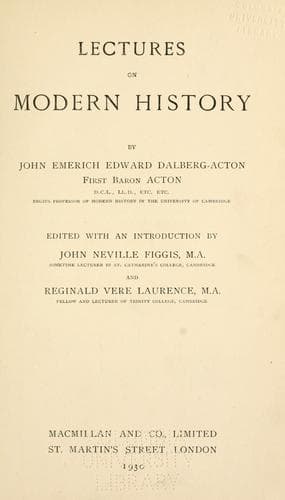
Lectures on Modern historyActon, John Emerich Edward Dalberg Acton, Baron
History
Lectures on Modern history
Acton, John Emerich Edward Dalberg Acton, Baron
History, Modern
Late in the day after that on which Coligny received his wound, the
civic authorities were warned to hold their men in readiness, when the
bell of the church near the Louvre, St. Germain of Auxerre, rang the
tocsin. This was the beginning of that alliance between the rural
aristocracy of Catholic France and the furious democracy of the
capital which laid the inauspicious foundation of the League. Their
objects were not entirely the same. The Parisian populace were
indiscriminately murderous and cruel, killing every Huguenot they
knew. The Spanish envoy wrote: "not a child has been spared. Blessed
be God!" Guise had his thoughts fixed on political enemies. Some
Protestant officers who lived beyond the Seine, hearing the tumult,
took horse and made off before it reached them, and were pursued by
Guise for many hours along the north road. When Guise gave up the
chase and returned to Paris, his house became a refuge for many
obscure persons from whom he had nothing to fear. In his absence, the
king had laid the blame upon him, and described the massacre as a
result of the old quarrel between Guise and Chatillon. This was not
to be borne, and another explanation was speedily devised. It was now
stated that a Protestant conspiracy had been discovered, and happily
crushed in time by a prompt effort in self-defence. This was
suggested by the threatening attitude assumed by Coligny's friends in
order to compel punishment for the attempt on his life. Both theories
were adopted in dealing with England and the German princes. Whilst
orders went forth to the local authorities all over France to imitate
the example of the capital, every effort was made to avert a breach
with the Protestant Powers.
These efforts were so successful that Elizabeth stood godmother to the
daughter of Charles IX, while his brother, Henry of Anjou, was elected
King of Poland by a union of parties, although his share in the
slaughter was notorious. This idea soon became preponderant; and when
provincial governors neglected or refused to obey the sanguinary
commands, nothing was done to enforce them. The actual massacre was a
momentary resolve: it was not a change of front.
Public-domain text, read in full here on John Shaqi.
Reviews
Reviews
No reviews yet
Be the first to share your thoughts on this work.
Elsewhere in the archive
Join the Discussion
Join the discussion
Sign in to leave a comment or review.
Sign InorCreate an account