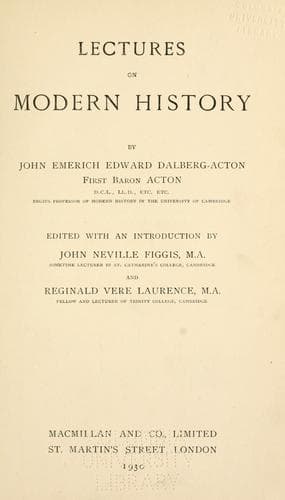
Lectures on Modern historyActon, John Emerich Edward Dalberg Acton, Baron
History
Lectures on Modern history
Acton, John Emerich Edward Dalberg Acton, Baron
History, Modern
The premeditation of St. Bartholomew has been a favourite controversy,
like the Casket Letters; but the problem is entirely solved, although
French writers, such as Guizot and Bordier, believe in it; and the
Germans, especially Baumgarten and Philippson, deny it. It is
perfectly certain that it was not a thing long and carefully prepared,
as was believed in Rome, and those who deny premeditation in the
common sense of the word are in the right. But for ten years the
court had regarded a wholesale massacre as the last resource of
monarchy. Catharine herself said that it had been in contemplation,
if opportunity offered, from the year 1562. Initiated observers
expected it from that time; and after the conference with Alva at
Bayonne, in 1565, it was universally considered probable that some of
the leaders, at least, would be betrayed and killed. Two cardinals,
Santa Croce and Alessandrina, announced it at Rome, and were not
believed. In 1569 Catharine admitted that she had offered 50,000
crowns for the head of Coligny, and corresponding sums for others.
The Archbishop of Nazareth reported to the Pope in the autumn of 1570
that the Treaty of St. Germain had been concluded with the intention
of slaughtering the Protestants when they were beguiled by the
favourable conditions granted them, but that the agents disobeyed. He
hoped that the Peace of St. Germain had the same legitimate motive
and excuse, and advised that a list of proscription should be drawn
up. In short, the idea had been long entertained, and had been more
than once near execution. At last, the murder of Coligny was provoked
by the imminent war with Spain, and the general slaughter followed.
The clergy applauded, but it did not proceed from them. Excepting
Sorbin at Orleans and the Jesuit Auger in the south, few of them were
actual accomplices before the fact. After the energetic approval
given by the court of Rome, it was not quite easy for a priest to
express dissent.
One dauntless ecclesiastic warned the Pope to prohibit demonstrations
which revealed the secret of the priesthood. The man who thus
disturbed the unanimity of exultant cardinals was Montalto, afterwards
Sixtus V, and he deserves to be recorded, because he outweighs many
names. He thought so ill of his predecessor, Gregory XIII, that he
was tempted to revoke the best act of his pontificate, the reformation
of the Calendar; and he was quite perspicacious enough to understand
that the massacre was the height of folly as well as the worst of
crimes.
Public-domain text, read in full here on John Shaqi.
Reviews
Reviews
No reviews yet
Be the first to share your thoughts on this work.
Elsewhere in the archive
Join the Discussion
Join the discussion
Sign in to leave a comment or review.
Sign InorCreate an account