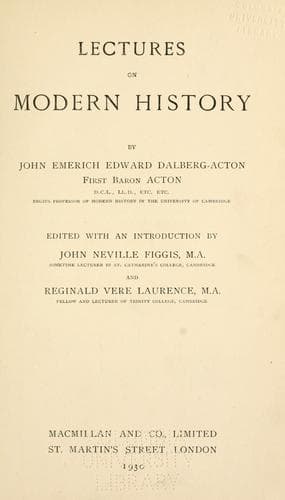
Lectures on Modern historyActon, John Emerich Edward Dalberg Acton, Baron
History
Lectures on Modern history
Acton, John Emerich Edward Dalberg Acton, Baron
History, Modern
Ferdinand's allies served him so well that they threw him into the
shade. The losses of the Protestants were not directly his gains.
For that, in order that he might reap the full harvest which others
had sown, he needed a great army commanded by a general of his own.
In due time he acquired both one and the other. He commissioned
Wallenstein to raise an Imperial force, independent of the League,
and to complete the conquest of Germany.
Wallenstein was a Bohemian noble, a convert and pupil of the Jesuits,
better known for his success in finance than in war. When the
confiscations were going on, he speculated in land. Having thriven
greatly, he lent large sums to the emperor. He gave valuable
assistance in debasing the coinage, and became by far the richest man
in the country. Watching the moment, he was able to offer Ferdinand
an army of 24,000 men, to be raised by himself, paid by himself,
commanded by himself, and by officers appointed by him. The object of
the armament was not to save the empire from the foe, for the foe was
being perpetually defeated; but to save the emperor from the League,
and the oppressive superiority of Bavaria.
It was the beginning of the Austrian army. The regiments that
followed Wallenstein to the sea still subsist, and are the same that
fought under Eugene and the archduke Charles. They were quickly
victorious; they overran Silesia, and at the bridge of Dessau they
gained a victory over Mansfeld.
Mansfeld was one of the mere adventurers who disgrace the war. But he
was a born soldier. Repulsed on the Elbe, he made his way through the
hereditary provinces, intending to embark at Venice for England. In a
Bosnian village his strength gave out. His death was nobler than his
life, and is a legendary reminiscence in Germany. For he buckled on
his armour, made his companions hold him upright, and met death
standing, with his drawn sword.
Wallenstein was rewarded by being made Duke of Mecklenburg and admiral
of the Baltic. He governed his principality well; but his fleet and
his docks were destroyed by the Danes, and he was forced to raise the
siege of Stralsund. He was unable to act in combination with Tilly
and the League. They wished to make their religion dominate, without
detriment to their position in the empire. Wallenstein meant that the
emperor should dominate, at the expense of the princes, whether
Catholic or Protestant, between whom he made no distinction. The very
existence of the force under his command implied that the purpose and
policy of the Habsburgs were not those of their allies, and that,
after profiting by their services, he meant to rob them of their
results. His imperialism was so dazzling, his success so unbroken,
that Ferdinand would not check him, but strove to appease the League
with fair assurances, and to induce its efficient leader Maximilian to
trust the commander-in-chief.
Public-domain text, read in full here on John Shaqi.
Reviews
Reviews
No reviews yet
Be the first to share your thoughts on this work.
Elsewhere in the archive
Join the Discussion
Join the discussion
Sign in to leave a comment or review.
Sign InorCreate an account