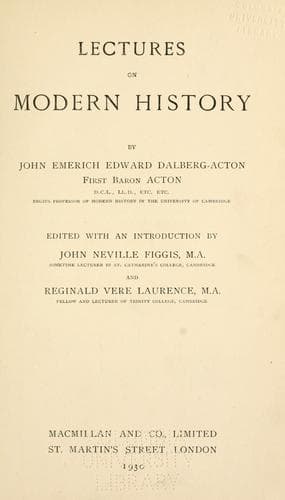
Lectures on Modern historyActon, John Emerich Edward Dalberg Acton, Baron
History
Lectures on Modern history
Acton, John Emerich Edward Dalberg Acton, Baron
History, Modern
As his
wife was the Princess Elizabeth, King James's only daughter, there was
hope of English aid. Without waiting to verify that expectation, the
elector quitted his castle at Heidelberg, and assumed the proffered
crown. But the coalition between Rhenish Calvinists and the Lutherans
of Prague did not work. The new subjects exhibited none of the
warlike vigour which, under Ziska, had made the Empire tremble; and
the Scottish father-in-law was too good a conservative and professor
of kingcraft to abet revolution.
When the army of the League, under Tilly, appeared before Prague, on
the slopes of what is called the White Mountain, there was no real
resistance, and the new king became a fugitive and an exile, dependent
on friends. As he spent but one winter in his capital, he is
remembered as the Winter King. For us, he is the father of Rupert and
of the Electress Sophia, from whom the king has his crown. Bohemia
was treated as a conquered country. The Protestant religion was
gradually suppressed, and the insurgents punished by immense
confiscations. The country, which had been civilised and prosperous,
was the first portion of the empire ruined by the outbreak of
hostilities. Ferdinand made the most of the Catholic triumph. Tilly
led his victorious army across Germany, from the Moldau to the Rhine.
The Palatinate was conquered. Frederic was outlawed, and Maximilian
of Bavaria became an Elector in his stead, so that the Catholic
Electors, who had been four to three, were now five to two. The
Heidelberg Library was removed from the castle, then the finest in
Germany, and was sent as a present to the Pope.
Tilly was a Belgian, born in the town of that name, near Waterloo, to
which Blucher retreated after Ligny. He had learnt war under Farnese,
and served with the League at Ivry. He fought against the Turks on
the Danube, and became a marshal in 1605. He was a soldier of the
Spanish school, rigid and severe; but he was no criminal, like Alva
and Farnese, and was the best and most trustworthy servant of the
Catholic cause in Germany. For ten years, from the White Mountain, he
carried all before him. The Union was dissolved. But German princes
and adventurers took arms one after the other, and dashed themselves
to pieces against him. When he was master of the valley of the Rhine,
foreign Powers, alarmed at his progress, began to intervene. France,
England, Holland, advanced funds, and Christian IV of Denmark led an
army into Northern Germany. Tilly defeated him, as he had defeated
every other enemy. His incessant success strengthened the Catholics,
the League, the Duke of Bavaria, more than the emperor.
Public-domain text, read in full here on John Shaqi.
Reviews
Reviews
No reviews yet
Be the first to share your thoughts on this work.
Elsewhere in the archive
Join the Discussion
Join the discussion
Sign in to leave a comment or review.
Sign InorCreate an account