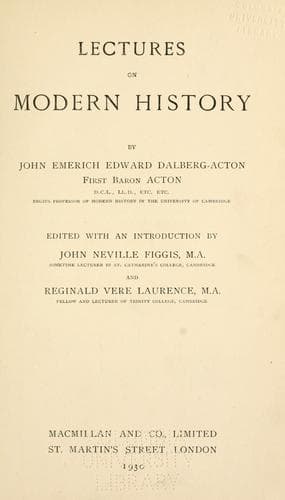
Lectures on Modern historyActon, John Emerich Edward Dalberg Acton, Baron
History
Lectures on Modern history
Acton, John Emerich Edward Dalberg Acton, Baron
History, Modern
When at length the way through Silesia to the heart of Austria lay
open before him, Tilly arrested his march by laying siege to
Magdeburg, which commanded the Elbe, and was a Protestant stronghold
in the North. The King of Sweden made no attempt to relieve the
besieged city; and in May 1631 Pappenheim, the hardest hitter among
the German commanders, took the place by storm. The defenders
deprived him of the fruits of victory by setting fire to Magdeburg,
and burning it to the ground. Tilly, with difficulty, saved the
Cathedral, and handed it over to the Catholics. He then took Leipzig
without resistance, hoping to coerce Saxony; but the Elector, in this
extremity, abandoned the neutrality he had maintained throughout the
war, and went over to the Swedes. At Breitenfeld, a few miles out of
Leipzig, Gustavus, feebly aided by the Saxons, defeated the
Imperialists in the greatest battle of the war. It was a victory of
the musket over the pike, and the beginning of the long struggle
between line and column. Tilly's ranks were ten deep, and the Swedes
only three, so that every musketeer fired. The world now perceived
that the tardy, patient soldier, who had seemed too cautious about his
retreat to prepare his advance, was a mighty conqueror, full of
invention and resource and untold design.
He struck at once for the heart of the empire, made himself master of
Wurzburg, and overran the ecclesiastical principalities of the Rhine,
which were the basis of Catholic power. At Mentz Gustavus held his
court, treating the princes as his inferiors, endeavouring to
conciliate the population. He did not live to declare his schemes of
policy; but all men knew that he meant to be the head of a great
Protestant Confederation, and to disarm their adversaries by
secularising the dominions of the clergy. He had made no settlement
for the future when he marched against Bavaria, the other stronghold
of the League. Below Augsburg Gustavus forced the passage of the
Lech, which Tilly disputed, and where the latter received the wound
of which he died soon after, in the impregnable fortress of
Ingolstadt. For more than two centuries his remains were so perfectly
preserved that I have looked on his austere features. Down to the
last months of his life he had been victorious over every foe, and was
the most dangerous enemy of the Protestant cause. Legend took
possession of him, and down to the last generation he was accused of
being the destroyer of Magdeburg, and of having, from mere fanaticism,
deprived himself of his prize. All that he had achieved in incessant
triumph fell to pieces at his first defeat; and the armies of the
League no longer stood between Gustavus, now at the head of 100,000
men, and the Austrian capital. But his career of success ended with
the fall of his great rival.
Public-domain text, read in full here on John Shaqi.
Reviews
Reviews
No reviews yet
Be the first to share your thoughts on this work.
Elsewhere in the archive
Join the Discussion
Join the discussion
Sign in to leave a comment or review.
Sign InorCreate an account