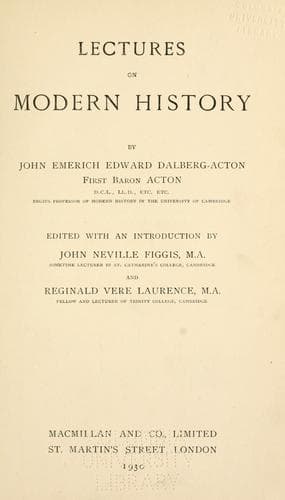
Lectures on Modern historyActon, John Emerich Edward Dalberg Acton, Baron
History
Lectures on Modern history
Acton, John Emerich Edward Dalberg Acton, Baron
History, Modern
When Tilly was defeated, the despairing emperor appealed once more to
Wallenstein, who was living in great splendour, aloof from affairs,
and showing as much capacity in the administration of his domains as
he had shown in war. It was not two years since he had been deposed
in disgrace, at the instance of the German princes. Therefore when,
in their extremity, they turned to him for protection, they placed
themselves in the power of an enemy on whom they had inflicted a
mortal injury. He had felt it so deeply that he was in actual treaty,
at the time, with Gustavus, for an expedition against Vienna. As Duke
of Mecklenburg he was an independent potentate, and he regarded
himself as released from the allegiance of a subject. Before breaking
off his negotiation with the Swede, he beheld his enemies at his feet.
Wallenstein was able to dictate his terms, and to make himself secure
against a second dismissal. His army was his own. He meant to obey
while obedience suited his purpose, and to act for himself when it did
not. Unlike Tilly, the aims of his life were political, not
ecclesiastical. With so many reasons for distrust on one side and
resentment on the other, a catastrophe could hardly be averted. With
Saxony and the Saxon general Arnim, who had been one of his colonels,
he kept up an understanding; and they evacuated Bohemia, which they
had occupied after Breitenfeld.
Wallenstein's new battalions came into line, and he took up a strong
fortified position near Nuremberg, with 60,000 men; while Gustavus
stood at the foot of the Alps, and his adherents wondered whether he
meant to cross them, and to attack Catholicism in its centre. When
the king knew that the imperial army had risen again, and threatened
his communications on the road through Franconia, he hurried to
measure swords with Wallenstein. He was heavily repulsed, and moved
once more towards the Danube, expecting to be followed. He was still
the dominating force in Germany, supported, if not trusted, by
Lutheran and Calvinist alike. At that moment Gustavus committed a
fatal mistake. If, as Oxenstiern advised, he had descended the valley
of the Danube into the hereditary provinces, the Imperialists must
have pursued him at a disadvantage, and could not have reached Vienna
before him. But Gustavus turned westward, towards Suabia, and
Wallenstein disregarded his movements. Gathering his forces, he threw
them upon Saxony, which had refused to give up the Swedish alliance.
The King of Sweden hastened to the rescue, while the Saxon army
stood apart, waiting the event. Pappenheim had been detached, and
the Swedes, in superior force, found a great opportunity before
them. But Wallenstein sent an order in good time to his famous
Lieutenant-divisionnaire, telling him to give up everything and
join at once. That paper, which saved the empire, one of the most
memorable autographs in the world, can still be seen, darkened with
Public-domain text, read in full here on John Shaqi.
Reviews
Reviews
No reviews yet
Be the first to share your thoughts on this work.
Elsewhere in the archive
Join the Discussion
Join the discussion
Sign in to leave a comment or review.
Sign InorCreate an account