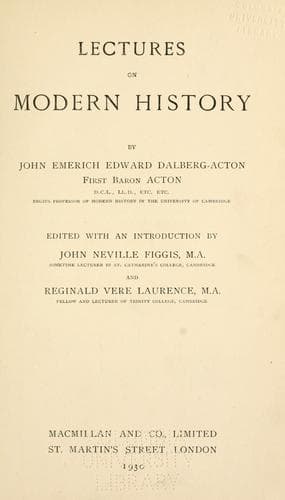
Lectures on Modern historyActon, John Emerich Edward Dalberg Acton, Baron
History
Lectures on Modern history
Acton, John Emerich Edward Dalberg Acton, Baron
History, Modern
The scheme which he proposed to the Saxons and Brandenburgers was the
restoration of peace on the principles of religious liberty; the
control of belief by Government abolished; everything rescinded which
had been done since 1618 in contradiction with this principle; the
departure of the Swedes to be purchased by an indemnity. These are
the main ideas. They were reasonable conditions of a lasting peace,
and would have saved many years of useless war, and prevented the ruin
of Germany. Wallenstein designed that the emperor should be compelled
to submit, if necessary, by a display of force. What Ferdinand wished
for beyond this, what he had striven for all along, the Catholic
domination, was hopeless. And if not hopeless, it was a thing not to
be desired, and not worthy of the cruel sacrifice of continued
warfare. It was the interest of Spaniard, Bavarian, and clergy to
frustrate Wallenstein's scheme. They represented that he was a
traitor, that he was plotting with the enemies of the empire, that he
crowded his camp with Protestants, that he wanted to be king, and
compassed the death of his master. Some of it was plausibly near the
truth; and their suspicions were confirmed when the Duke of Weimar
took Ratisbon. The Elector of Bavaria had sent full warning; the
Aulic Council had sent positive orders. But Wallenstein refused to
move.
Fearing that he might be deposed before he could execute what he had
long meditated, he summoned his colonels to Pilsen, and threatened to
resign. They pledged themselves to stand by him. The clause, saving
their duty to the emperor, was struck out of the declaration by him.
He still hoped to succeed. But Ferdinand issued orders that he should
be no longer obeyed; and these orders, proclaimed at Prague to sound
of drum, were accepted by the army. A successor was appointed;
Piccolomini, the real victor at Lutzen, was made field-marshal; and
the officers were drawn away by the prospect of the impending
confiscations. They amounted, eventually, to fourteen millions of
florins. The Spanish envoy, Onate, at last sent word in Ferdinand's
name that Wallenstein should be mastered, alive or dead. Wallenstein
understood that he was in danger, and begged Weimar to come to his
assistance with cavalry.
Public-domain text, read in full here on John Shaqi.
Reviews
Reviews
No reviews yet
Be the first to share your thoughts on this work.
Elsewhere in the archive
Join the Discussion
Join the discussion
Sign in to leave a comment or review.
Sign InorCreate an account