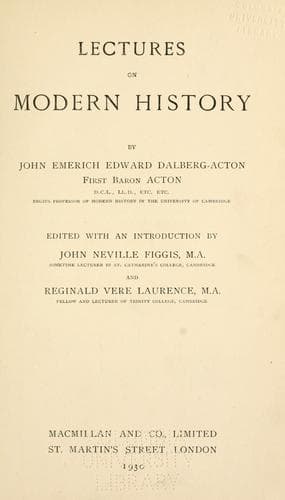
Lectures on Modern historyActon, John Emerich Edward Dalberg Acton, Baron
History
Lectures on Modern history
Acton, John Emerich Edward Dalberg Acton, Baron
History, Modern
He started from Pilsen, with the remnant of his troops, to meet Weimar
at Eger, where two Scotch Presbyterians were in command, who inspired
confidence. But on the way he met the Irish regiment of dragoons,
with their colonel, Butler, and required them to accompany him. They
were going to Prague, to join his enemies, and were the authors of his
death. Butler persuaded the two Scotsmen, Lesley and Gordon, and the
few officers, known to be Wallenstein's immediate friends, were
invited to a banquet in the castle of Eger, and there cut down. When
the Countess Kinsky, who was the wife of one of them, learnt of her
husband's death, she had the presence of mind instantly to destroy his
papers, and the secret of Wallenstein's treason was lost in that
conflagration. Devereux, one of Butlers captains, went with a handful
of men to the general's quarters and despatched him. The deed was
approved by the emperor, and the murderers were rewarded. This is the
dramatic end of the struggle, so far as it was caused by genuine
problems of Church and State.
A war of aggression and desolation ensued, and lasted many years,
without higher significance. When the Imperialists had gained another
victory at Nordlingen, Lutheran Saxony made its peace, at Prague, in
1635.
Then Richelieu took up the conflict, to carry on his feud with both
branches of the House of Habsburg, and the empire sank lower and
lower, German princes and generals betraying their country to the
national enemy. In 1643, when Richelieu was dead, a chance of peace
began. Five years later it was concluded for Germany, at Munster and
Osnabruck, not for Spain. The Empire lost much in population and
territory, which were taken by France; still more in authority, which
fell from the emperors hands into the hands of the several princes,
now virtually sovereign and subject to no control. The peace of
Westphalia gave no accession to the Protestant interest.
In extension, the Protestants lost by the Thirty Years' War. They
lost one-half of the Palatinate, incorporated in Bavaria; and they
submitted to exclusion from the Austrian dominions, all but Silesia.
Calvinists were now admitted to equal rights with the rest.
Protestants and Catholics recovered what they had possessed in 1624.
Therefore the cause of the insurgent Bohemians was abandoned, and the
men who were thrown out of the window triumphed in the end.
Concerning liberty of conscience, not a word was said. The power of
the interfering State was not shorn, but the idea that the division of
Christendom might be healed by force passed away from the minds of
men. It had taken thirty years of incessant bloodshed to extinguish
the Counter-Reformation.
XI
THE PURITAN REVOLUTION
Public-domain text, read in full here on John Shaqi.
Reviews
Reviews
No reviews yet
Be the first to share your thoughts on this work.
Elsewhere in the archive
Join the Discussion
Join the discussion
Sign in to leave a comment or review.
Sign InorCreate an account