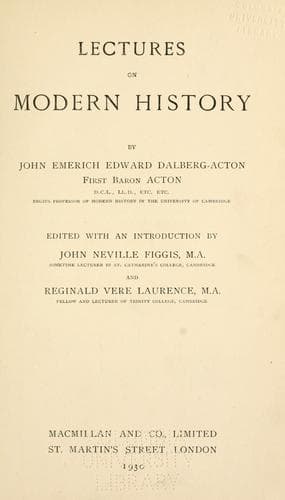
Lectures on Modern historyActon, John Emerich Edward Dalberg Acton, Baron
History
Lectures on Modern history
Acton, John Emerich Edward Dalberg Acton, Baron
History, Modern
The political consequences reached far. The supremacy of the people,
being accepted in Church government, could not be repudiated in the
State. There was a strong prejudice in its favour. "We are not over
one another," said Robinson, "but one with another." They inclined
not only to liberty, but to equality, and rejected the authority of
the past and the control of the living by the dead. The sovereignty
of the yellow parchment fell before the light of reason. As there
was no State Church, there could be no right of coercion over
consciences. Persecution was declared to be spiritual murder. The
age of Luther and the Reformation was an age of darkness. All sects
alike were to be free, and Catholics, Jews, and Turks as well. The
Independents fought, as they expressed it, not for their religion, but
for liberty of conscience, which is the birthright of man. There was
no place in their creed for a special prerogative of Englishmen over
other nations, or of Independents over other churches. All this was
in the stringent logic of the system, the immediate consequence of
their dogmas on the constitution of the Church, and this gave to their
liberalism the invaluable foundation of religion. Not every one of
them saw equally far, or applied principles with equal courage. In
the matter of tolerance they were supported by the Baptists, and,
after the appearance of Penn, by the Quakers, though their historian
deplores it as an unheard-of dogma. In 1641 there was only one
congregation in London, and it consisted of sixty or seventy members.
Ten years earlier Lord Brooke writes that there were not above two
hundred Nonconformists in all England. It is clear that the rapid
growth of numbers baffled all calculation. The Independents did not
bring on the Civil War, but they were strong enough to bring it to a
conclusion; and when all the direct effects of their victory passed
away, their ideas survived.
Public-domain text, read in full here on John Shaqi.
Reviews
Reviews
No reviews yet
Be the first to share your thoughts on this work.
Elsewhere in the archive
Join the Discussion
Join the discussion
Sign in to leave a comment or review.
Sign InorCreate an account