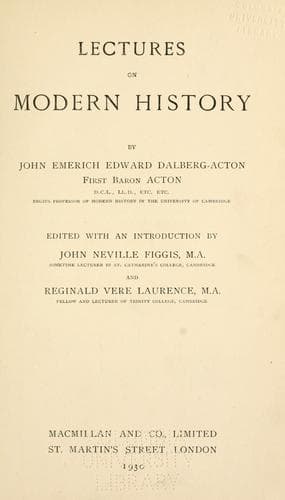
Lectures on Modern historyActon, John Emerich Edward Dalberg Acton, Baron
History
Lectures on Modern history
Acton, John Emerich Edward Dalberg Acton, Baron
History, Modern
James's reign is also the beginning of colonial empire. Virginia was
a cavalier settlement, proceeding from the epoch of exploration and
the search for gold; and New England was a plebeian and sectarian
establishment, planted by men who fled from oppression. They did not
carry with them very clear notions of human right; but these ripened
under their oppressive rule among those whom they persecuted. There
were local self-government and federation in Connecticut, and spiritual
self-government and toleration in Rhode Island; and from there the two
institutions spread to the United States, and when the time came, the
cavaliers of Virginia, who went out under James I, surpassed the
fugitives of the Mayflower. They produced the Declaration of
Independence, and bequeathed to America religious liberty and the
political function of the Supreme Court. Of the first five
presidents, four were Virginians. And in our own history, the ablest
of the men who resisted Cromwell had studied practical politics in
Massachusetts Bay.
The third political event by which the reign of the first Stuart
profoundly influenced the modern world is the rise of those whom we
call Congregationalists when we think of them as a Church, and
Independents when we mean a party. It is on their account that this
epoch is more fitly called the Puritan Reformation than the Puritan
Revolution. For it is by the sects, including the Independents, that
the English added to what was done by Luther and Calvin, and advanced
beyond the sixteenth-century ideas. Continental Protestantism reacted
on the Anglican settlement, and our exiled sectaries, before crossing
the Atlantic, came into touch, in Holland, with the most original and
spiritual remnant of the German Reformation. There Robinson completed
the system of Robert Browne, a secondary and uninspiring figure, of
whom we read: "Old father Browne, being reproved for beating his old
wife, distinguished that he did not beat her as his wife, but as a
curst old woman."
The power of Independency was not in relation to theology, but to
Church government. They did not admit the finality of doctrinal
formulas, but awaited the development of truth to come. Each
congregation governed itself independently, and every member of the
Church participated in its administration. There was consociation, but
not subordination. The Church was governed, not by the State or by
bishops or by the presbytery, but by the multitude of which it was
composed. It was the ideal of local self-government and of
democracy. Institutions which are the work of History were abolished
in favour of popular control; and an Established Church, a Church
connected with the State, was the supreme abomination, and went by the
name of Babylon.
Public-domain text, read in full here on John Shaqi.
Reviews
Reviews
No reviews yet
Be the first to share your thoughts on this work.
Elsewhere in the archive
Join the Discussion
Join the discussion
Sign in to leave a comment or review.
Sign InorCreate an account