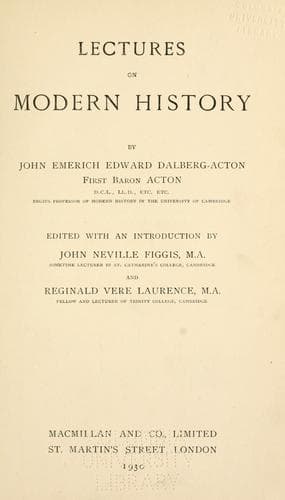
Lectures on Modern historyActon, John Emerich Edward Dalberg Acton, Baron
History
Lectures on Modern history
Acton, John Emerich Edward Dalberg Acton, Baron
History, Modern
The changes now introduced went to strengthen not the prerogative, but
the gentry, who were the governing class. They were relieved from the
payment of feudal dues, by means of a tax which fell on other classes;
members were taken from the towns and added to the country districts;
and the militia, which was to protect society from the parliamentary
army, was placed in the hands of the gentry. The new order of things
was the work not of a party, but of a class. The dominant cavaliers
were willing to refuse a share in their power to the old Puritan
enemy, and passed every measure for inflicting disabilities on the
Nonconformists. They were excluded from all offices, in the Church and
in the State, even in the municipalities. In this way, by a religious
test, the class that consisted mainly of Churchmen secured all
political authority for themselves. They, however, added a political
test. They imposed an oath in favour of non-resistance. Nobody could
hold office who was not what was afterwards known as a Tory. This was
Anglican doctrine; and the clergy set to work to rule the country in
conjunction with the conservative country gentlemen, on a basis of
principles laid down by Hobbes, the philosopher of the day, who denied
the right, and even the existence of conscience.
Clarendon was minister; and it was an ingenious and politic thing in
his eyes to suppress the Roundhead by suppressing the Presbyterian.
He had reflected more deeply than any man then living on the problem
of Church and State; and he did not believe in the sacred fixity of
divisions founded on schemes of Church government only. Archbishop
Ussher had made great concessions to the Presbyterians. Baxter had
made concessions to Prelacy. The see of Hereford was offered to him,
and it was thought he might accept it. Leighton, who was as much the
greatest Puritan divine in Scotland as Baxter in England, did accept
the offer of a mitre, and became Archbishop of Glasgow. The restored
government was intolerant, because, by intolerance, it could exercise
political repression. This did not apply to the Catholics. Clarendon
had pledged himself that they should profit by the indulgence which
was afterwards promised at Breda. When he adopted the policy of
coercion against the Puritans, he was unable to keep his promise. The
unnatural situation could not last after his fall. The Puritans had
made war upon the throne, and the Catholics had defended it. When it
was restored, they proclaimed their principles in a series of
voluntary declarations which dealt with the customary suspicions and
reproaches, and fully satisfied the purpose aimed at by the oath of
allegiance. No people could be more remote from the type of Allen and
Parsons than the English Benedictines and the Irish Franciscans who
hailed the revived monarchy. Against such men the old argument of
Elizabethan persecutors was vain.
Public-domain text, read in full here on John Shaqi.
Reviews
Reviews
No reviews yet
Be the first to share your thoughts on this work.
Elsewhere in the archive
Join the Discussion
Join the discussion
Sign in to leave a comment or review.
Sign InorCreate an account