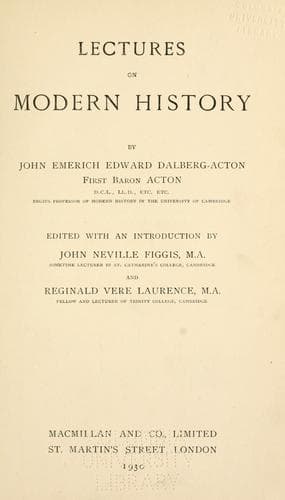
Lectures on Modern historyActon, John Emerich Edward Dalberg Acton, Baron
History
Lectures on Modern history
Acton, John Emerich Edward Dalberg Acton, Baron
History, Modern
After the fall of Clarendon a different policy was attempted. The
rigid exclusiveness of the Puritans had bequeathed one sinister vice
to the English people. They were complacent in their insularity, and
had a prejudice against the foreigner. It had been directed against
Spain, for the sake of Plate fleets to seize and coasts to pillage;
and now it was strongest against the Dutch, who were dangerous rivals
by sea, both in peace and war. It was least, at that time, against
France, whose great statesman, Mazarin, had made terms with the
Republic, and retained the friendship of the restored king. A trivial
dispute on the Guinea Coast was fanned into a quarrel by the Duke of
York, who was a sailor, and who hoped to strengthen his position at
home by his professional skill, in which he only partially
succeeded. This is the war that terminated in the memorable change of
front of the Triple Alliance, uniting the Dutch, the English, and the
Swedes against France. It was a popular but totally ineffective
measure; and in 1669 England abandoned her allies and went over to
France. Lewis XIV accomplished this important diplomatic success by
the Treaty of Dover, the first in the process of events that overthrew
the Stuart monarchy, and brought in the modern type of Constitution.
Soon after his return to England, Charles opened negotiations with
Rome, which were carried on through one of his sons, born before
Monmouth, who became a Jesuit; and he vainly endeavoured to obtain
supplies from Alexander VII. Later on, he sought them in France. It
was impossible, he said, to restore the royal authority unless it was
done through the restoration of Catholicism. That could be secured, if
Lewis would make him independent of the House of Commons. The scheme
was prepared in January 1669, Arlington consenting, for a bribe of
L12,000. It was decided to restore the Catholic Church in England by
such a display of force as should be sufficient to raise the crown
above the restraints of parliament. In execution of the design Lewis
advanced L80,000, and undertook, in case of resistance, to furnish a
force of 6000 men, to be a French garrison in England, for the
repression of Protestants. The sum was much less than Charles
demanded, for the object of the French king was not to strengthen, but
to weaken him. The second point in the Treaty was that England engaged
to support France in any claims she might have upon Spain. Lastly,
England was to help her ally against Holland, in return for further
payments and the annexation of Walcheren. But it was agreed to
postpone the Dutch war until the year 1672. That is the solid
substance of the phantom which is called the Popish Plot.
It was, in reality, a plot, under cover of Catholicism, to introduce
absolute monarchy, and to make England a dependency of France, not
only by the acceptance of French money, but by submission to a French
army. Charles I and his ministers had gone to the block for less than
this.
Public-domain text, read in full here on John Shaqi.
Reviews
Reviews
No reviews yet
Be the first to share your thoughts on this work.
Elsewhere in the archive
Join the Discussion
Join the discussion
Sign in to leave a comment or review.
Sign InorCreate an account