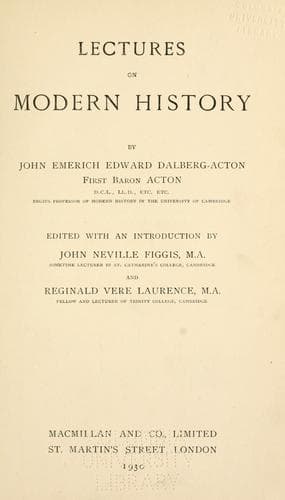
Lectures on Modern historyActon, John Emerich Edward Dalberg Acton, Baron
History
Lectures on Modern history
Acton, John Emerich Edward Dalberg Acton, Baron
History, Modern
him not to rely on the passive obedience of Churchmen. James replied
that the bishop had lost his nerve.
Having decided to risk a quarrel with loyal Anglicans, he assumed the
dispensing power. The judges approved. There was a precedent in his
favour. He had support not only in the past but in the future, for
William III followed his example. He could claim that he was acting
for the reason of State against shameful prejudice and sordid passion.
The greatest historic figure of the age, William Penn, was on his
side, and went over to explain the principle of his policy to the
Prince of Orange. Lewis XIV urged him on. And although the body of
English Catholics were much opposed, his immediate advisers, who were
men in the French interest, or survivors of the Dover Treaty, Arundel,
Bellasis, Dover, Tyrconnel, encouraged his fixed design. A few men in
high office, he said, would do more for Catholicism than many hearing
mass without impediment.
We must imagine not a sinister tyrant brooding schemes of oppression,
but an unintelligent absolutist, in the hands of men, some of whom
were able and some sincere, plying him with plausible arguments.
Therefore, when the primate and six bishops protested against the
Declaration of Indulgence, James sent them to the Tower. Sunderland
advised caution. The time for extreme measures, he said, had not
come. The violent members of the council thought that they had their
enemies at their mercy and they prevailed.
James thought that he was triumphing, for just then the Prince of
Wales was born. The future of his policy was assured. The crown was
not to pass to the head of the Protestant interest in Europe. James's
enemies, says the imperial envoy, gave up their cause for lost. In
their despair they at once invented the lie about the warming pan.
James's opportunity had come. He could declare an amnesty for the
event which had so profoundly changed his fortunes. The seven bishops
could be released without a trial, and the impending catastrophe could
be averted. The king, disagreeing with his advisers, with Sunderland,
with the nuncio, even with Jeffreys, determined to go on. He intended
that the bishops should be tried, condemned, and pardoned. With that,
his victory would be complete. Instead of which, the bishops were
acquitted, and the king's attack on the Church ended in defeat.
Public-domain text, read in full here on John Shaqi.
Reviews
Reviews
No reviews yet
Be the first to share your thoughts on this work.
Elsewhere in the archive
Join the Discussion
Join the discussion
Sign in to leave a comment or review.
Sign InorCreate an account