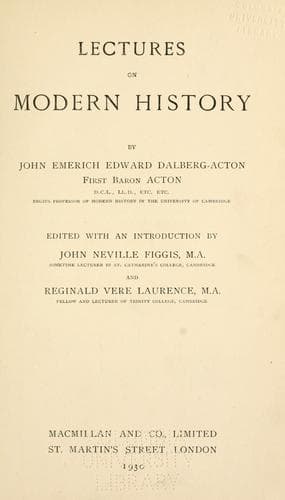
Lectures on Modern historyActon, John Emerich Edward Dalberg Acton, Baron
History
Lectures on Modern history
Acton, John Emerich Edward Dalberg Acton, Baron
History, Modern
There was an Irish divine, Martin of Connemara, who suggested that, in
time of war, it would be well that a chosen band should devote
themselves to the task of falling upon the Prince of Orange and
putting him to death. It would, he said, be a legitimate act of
warfare. Lewis XIV required no such arguments, and sent a miscreant
named Grandval to rid him of the obnoxious prince. Berwick preferred
the advice of the theologian, and, at the battle of Landen, he led a
troop of 200 horsemen to the place where his kinsman stood, crying out
to them to kill him. Three years later, in 1696, he was in London,
communicating with the managers of the plot, who thought that it would
be no murder to shoot the king on the road to Hampton Court, when
surrounded by his guards. A beacon fire on Shakespeare's Cliff was to
send the news across the sea, and at that signal James was to come
over, in French ships. When the plot thickened, Berwick made his
escape, and met his father changing horses at Clermont. Having learnt
how matters stood, James pursued his way to Calais, and there, while
he watched the northern horizon for the desired signal, he wrote
edifying letters to the Abbe de Rance. When the plot was betrayed he
showed the deepest sympathy with the assassins, and never lamented
their crime.
The series of measures by which he lost the crown form a drama in
three acts. First, he tried to obtain the co-operation of the
Established Church. When that failed, he turned against the Church
and worked through the Dissenters. And then he brought on that
quarrel with the clergy which proved fatal to him. James did not
believe in the reality of Protestant religion. Sunderland assured him
that in two years not a Protestant would be left in England, if
compulsion ceased, and his mind was bewildered by two very remarkable
facts. One of these was the theology of recent Caroline divines.
Archbishop Bramhall could hardly be distinguished from a Gallican.
Archbishop Leighton was in close touch with Jansenists. One Roman
doctrine was adopted by Montagu, another by Thomdike, a third by Isaac
Barrow. Bull received the thanks of the French clergy for his
vindication of the early fathers against the most learned of the
Jesuits. To an ignorant and narrow-minded man all these things
pointed to one conclusion, the instability and want of solidity in the
Anglican system. Then there was the astounding collapse of the French
Huguenots. Lewis boasted that, in a few months, without real
violence, he had effected 800,000 conversions. And James was eager to
believe it. He asked himself, says Barillon, why he could not do as
much in England. He desired the Roman congregations to examine the
question, whether the English bishops might retain their sees. Some
said they would be better than the Catholic clergy, who were accused
of Jansenism. One thing he considered absolutely certain. The Church
would never resist his authority. The Bishop of Winchester entreated
Public-domain text, read in full here on John Shaqi.
Reviews
Reviews
No reviews yet
Be the first to share your thoughts on this work.
Elsewhere in the archive
Join the Discussion
Join the discussion
Sign in to leave a comment or review.
Sign InorCreate an account