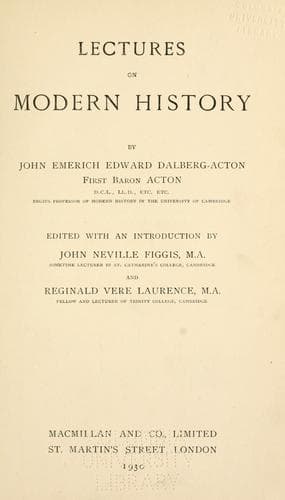
Lectures on Modern historyActon, John Emerich Edward Dalberg Acton, Baron
History
Lectures on Modern history
Acton, John Emerich Edward Dalberg Acton, Baron
History, Modern
On this state of feeling, far stronger in 1688 than in 1695, William
built his plan. It was in the power of Lewis at any moment to prevent
the expedition. He had an army ready for war, and could have held
William fast by sending it against the Netherlands. He preferred to
attack the empire on the Upper Rhine. For twenty years it had been
his desire to neutralise England by internal broils, and he was glad
to have the Dutch out of the way while he dealt a blow at Leopold. It
was impossible that the conflict between James and William should not
yield him an opportunity. For the beginning he stood carefully aside,
letting things take their course. There was no resistance, by land or
sea, and it proved almost as easy to dethrone the Stuarts as it had
been to restore them. The balance of parties, the lack of energetic
conviction in England, had allowed things to settle down, when the
real struggle began, in Ireland, in Scotland, and in the Channel. The
Scots rising did not postpone the issue, but it is valuable to us for
the sake of one transaction.
The deed that was done in Glencoe is familiar to us all, by a patch
of Tyrian purple in the most splendid of our histories. It affords
a basis for judging the character of William and of his government.
They desired that some of the Highlanders should stand out, that an
example might be made; and they hoped that it might be the one
Catholic clan, as they were likely to be the most dangerous
Jacobites. "Who knows," wrote Stair, "but, by God's providence, they
are permitted to fall into this delusion that they may only be
extirpat." Four days later another writes: "The king does not care
that some do it, that he may make examples of them." Accordingly, by
his orders, one branch of the Macdonalds was destroyed by Campbell of
Glenlyon. There is no doubt about the order. But it is not certain
that William knew that the chieftain had taken the oath. The people
concerned were rewarded in due proportion. One became a colonel,
another a knight, a third a peer, and a fourth an earl. It was a way
King William had. When the murder of De Witt made him supreme, he
kept away from The Hague, but then saw that the murderers were
recompensed. Eighty years later a deserter from one of our regiments
was under sentence to be shot. The officer commanding the firing
party, another Captain Campbell of Glenlyon, had received a reprieve,
with secret orders not to produce it until the culprit stood facing
the levelled muskets. At that moment, as he drew the reprieve from
his pocket, his handkerchief, coming with it, fell to the ground. The
soldiers took it for their signal and fired. Glenlyon exclaimed, "It
is the curse of Glencoe!" and at once left the service.
Public-domain text, read in full here on John Shaqi.
Reviews
Reviews
No reviews yet
Be the first to share your thoughts on this work.
Elsewhere in the archive
Join the Discussion
Join the discussion
Sign in to leave a comment or review.
Sign InorCreate an account