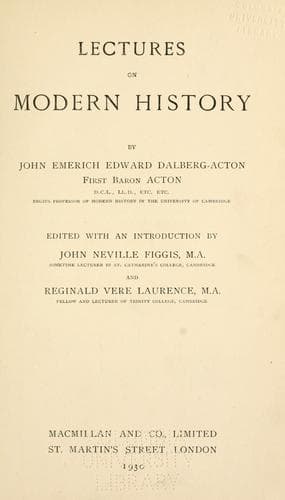
Lectures on Modern historyActon, John Emerich Edward Dalberg Acton, Baron
History
Lectures on Modern history
Acton, John Emerich Edward Dalberg Acton, Baron
History, Modern
When James escaped to France, he at once went over to Ireland, with a
French army, while a French fleet covered the expedition and swept the
Channel. James had long intended to make Ireland independent of
England, that, under his Protestant successors, it might be an
impregnable refuge for persecuted Catholics. He estimated that it
would take five years of preparation. Tyrconnel also contemplated
separation, and arranged for a French invasion, if James died. When
James came over Tyrconnel thought him hopelessly incompetent, and
offered his country to Lewis XIV. Sarsfield detested his treachery,
and invited Berwick to undertake the government. Of James's French
counsellors, one was Lauzun, who commanded the auxiliary army, and
proposed to burn Dublin to the ground and ravage the open country.
The other was the ambassador D'Avaux, who wished him to make short
work of all the Protestants in the island.
James rejected the advice with indignation. Lewis also rejected it,
but without the indignation you would expect in a most Christian king,
and without thinking the adviser unworthy of his service. D'Avaux
relates it all, without reserve, in his despatches, which are among
the curiosities of History. They were printed at the Foreign Office,
and never published. The only copy I ever saw was uncut when it came
into my hands.
In spite of these discordant counsels, the Jacobite prospects in
Ireland brightened when a fleet of seventy-eight ships sailed from
Brest. "If they were only commanded by De Ruyter," said Louvois,
whose control stopped with the shore, "there would be something to
hope for." Instead of De Ruyter, Tourville defeated the combined
Dutch and English at Beachy Head. The allies lost sixteen ships out
of fifty-eight; the French not one. Tourville was master of the
Channel. Torrington left the Dutch to do the fighting, and kept as
far as he could from the scene of danger. He had to lament the death
of his favourite dog. They said that the dog died the death of an
admiral, and the admiral lived the life of a dog. That 30th of June
is the most disgraceful date in our naval annals.
On the following day the battle of the Boyne was won not in the
legendary manner, by William, with his sword in his left hand, or
Schomberg, plunging into the river to meet a soldiers death, but by
the younger Schomberg, who crossed higher up and outflanked the
French. Tourville's victory, after that, was entirely useless.
William offered an amnesty, which was frustrated by the English hunger
for Irish estates; and the capitulation of Limerick, rejected by the
Irish parliament, gave it the name of the City of the Broken Treaty.
Public-domain text, read in full here on John Shaqi.
Reviews
Reviews
No reviews yet
Be the first to share your thoughts on this work.
Elsewhere in the archive
Join the Discussion
Join the discussion
Sign in to leave a comment or review.
Sign InorCreate an account