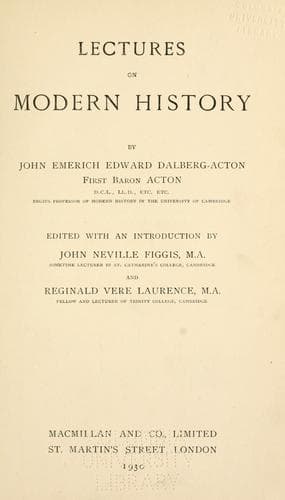
Lectures on Modern historyActon, John Emerich Edward Dalberg Acton, Baron
History
Lectures on Modern history
Acton, John Emerich Edward Dalberg Acton, Baron
History, Modern
It is associated with that philosophy which Cato attributes to
the gods. For we have a theory which justifies Providence by the
event, and holds nothing so deserving as success, to which there
can be no victory in a bad cause; prescription and duration
legitimate #93; and whatever exists is right and reasonable; and as
God manifests His will by that which He tolerates, we must
conform to the divine decree by living to shape the future after
the ratified image of the past #94. Another theory, less confidently
urged, regards History as our guide, as much by showing errors to
evade as examples to pursue. It is suspicious of illusions in
success, and, though there may be hope of ultimate triumph for
what is true, if not by its own attraction, by the gradual
exhaustion of error, it admits no corresponding promise for what
is ethically right. It deems the canonisation of the historic
past more perilous than ignorance or denial, because it would
perpetuate the reign of sin and acknowledge the sovereignty of
wrong, and conceives it the part of real greatness to know how to
stand and fall alone, stemming, for a lifetime, the contemporary
flood #95.
Ranke relates, without adornment, that William III ordered the
extirpation of a Catholic clan, and scouts the faltering excuse
of his defenders. But when he comes to the death and character
of the international deliverer, Glencoe is forgotten, the
imputation of murder drops, like a thing unworthy of notice #96.
Johannes Mueller, a great Swiss celebrity, writes that the
British Constitution occurred to somebody, perhaps to Halifax.
This artless statement might not be approved by rigid lawyers as
a faithful and felicitous indication of the manner of that
mysterious growth of ages, from occult beginnings, that was never
profaned by the invading wit of man #97; but it is less grotesque
than it appears. Lord Halifax was the most original writer of
political tracts in the pamphleteering crowd between Harrington
and Bolingbroke; and in the Exclusion struggle he produced a
scheme of limitations which, in substance, if not in form,
foreshadowed the position of the monarchy in the later Hanoverian
reigns. Although Halifax did not believe in the plot #98, he
insisted that innocent victims should be sacrificed to content
the multitude. Sir William Temple writes: "We only disagreed in
one point, which was the leaving some priests to the law upon the
accusation of being priests only, as the House of Commons had
desired; which I thought wholly unjust. Upon this point Lord
Halifax and I had so sharp a debate at Lord Sunderland's
lodgings, that he told me, if I would not concur in points which
were so necessary for the people's satisfaction, he would tell
everybody I was a Papist. And upon his affirming that the plot
must be handled as if it were true, whether it were so or no, in
those points that were so generally believed." In spite of this
accusing passage, Macaulay, who prefers Halifax to all the
Public-domain text, read in full here on John Shaqi.
Reviews
Reviews
No reviews yet
Be the first to share your thoughts on this work.
Join the Discussion
Join the discussion
Sign in to leave a comment or review.
Sign InorCreate an account