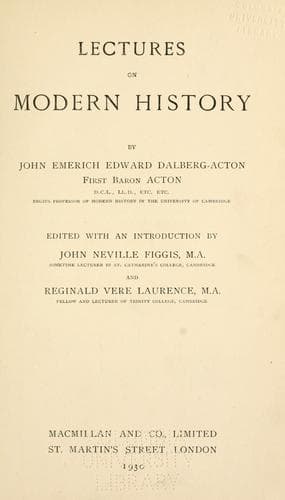
Lectures on Modern historyActon, John Emerich Edward Dalberg Acton, Baron
History
Lectures on Modern history
Acton, John Emerich Edward Dalberg Acton, Baron
History, Modern
Mazarin, the ablest and most successful of ministers, had one damning
vice. He was shamefully avaricious. He amassed, in the service of the
State, therefore dishonestly, an income larger than that of the King
of England or the King of Spain. The necklace of pearls which he gave
to one of his nieces, and which is at Rome, is said to be still the
finest in existence. But Mazarin, though he was sordid and mean, was a
statesman of the highest rank. He sent his niece away, in spite of the
tears of Lewis, and the Spanish princess became Queen of France. The
independence of Spain, the unity of the Spanish empire, were too grand
a thing to be an item in the dowry of a bride. She was compelled to
renounce her rights, which were transferred to her sister. The
renunciation was conditional. It was to depend on the payment, in due
time, of the Infanta's fortune. As the payment was not made, the
French regarded the surrender as null and void, and the interest at
stake, the most splendid inheritance on earth, was one that could not
be given up without a conflict. From the moment of the marriage the
main object of French policy was to make the succession secure, by
negotiation or force, and to take every advantage otherwise of Spanish
weakness.
All these plans were doomed to a terrible disappointment. In 1665
Philip of Spain died; but he had married again, and left a son, who
became king, in his cradle, under the name of Charles II. The new
king was sickly and backward, and it was expected that he would die
young, unmarried, and childless. Meantime, the fulfilment of French
hopes was postponed for a generation, and the Spanish succession was
opened, not at the beginning of Lewis's reign, but at the end. He
recovered from the blow by a device to acquire part of the Spanish
empire, no longer having a hope of the whole. The device was
suggested by Turenne. His experience in the Fronde taught him the
danger of having the Spaniards so near, in the valley of the
Somme. "Whenever there is trouble in France," he said, "the enemy can
be at Paris in four days." In self-defence, for security rather than
aggrandisement, the frontier must be pushed back. He caused his
secretary to compose a treatise, showing that, by the custom of
Brabant, that province devolved on the queen, Maria Theresa. It was
the custom there that the children of a first marriage should suffer
no loss if their father married again. What would have been their
estate, remained their estate. The fee simple passed to them. The
father enjoyed a life-interest only, without the power of disposal.
The French government argued that, by the analogy of the Salic Law,
the principle which applied to property applied to sovereignty, and
that what was good for a manor was good for a crown. And they assumed
that the custom of Brabant was the law of Belgium.
Public-domain text, read in full here on John Shaqi.
Reviews
Reviews
No reviews yet
Be the first to share your thoughts on this work.
Elsewhere in the archive
Join the Discussion
Join the discussion
Sign in to leave a comment or review.
Sign InorCreate an account