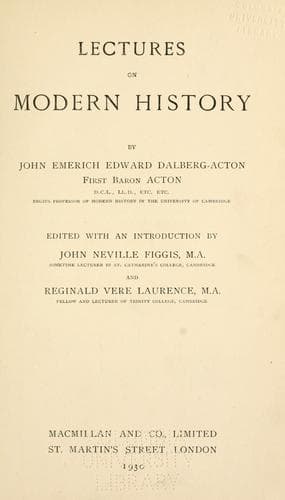
Lectures on Modern historyActon, John Emerich Edward Dalberg Acton, Baron
History
Lectures on Modern history
Acton, John Emerich Edward Dalberg Acton, Baron
History, Modern
Lewis XIV was by far the ablest man who was born in modern times on
the steps of a throne. He was laborious, and devoted nine hours a
day to public business. He had an excellent memory and immense
fertility of resource. Few men knew how to pursue such complex
political calculations, or to see so many moves ahead. He was patient
and constant and unwearied, and there is a persistent unity in his
policy, founded, not on likes and dislikes, but on the unvarying facts
in the political stage of Europe: Every European state was included in
his system, and had its part in the game. His management of each was
so dexterous that diplomacy often made war superfluous, and made it
successful. Lewis was not a born soldier like Swedish Charles and the
great Frederic. He never exercised an actual command. He would
appear at sieges when the psychological moment came, and ride
ceremoniously under fire, with his Jesuit confessor close at hand. His
fame was so large a part of the political capital of France, that a
pretence was made of believing in his generalship, and the king took
it quite seriously. He told his son to go to the wars and prove his
warlike quality, that the change, when his father died, might not be
too deeply felt. In many places he was accepted as a benefactor and a
That was generally the case in Switzerland, in Portugal, in Denmark
and Sweden, in Poland and Hungary, in parts of Germany, and in parts
of Italy. For in small countries public men poor and easily consented
to accept his gifts. In this way he strove to prevent coalitions and
to isolate his enemies. The enemies were Austria and the Netherlands.
Two facts governed the European situation. One was the break-up of
the imperial power in Germany, after the Thirty Years' War. The
effect of it was that France was fringed by a series of small
territories which were too feeble to defend themselves, and which
Germany was too feeble and too divided to protect. There were
Belgium, Liege, Luxemburg, Lorraine, Alsace, and Franche Comte. The
other overshadowing fact was the evident decay of Spain, of the royal
family as well as of the nation. Belgium, Luxemburg, and Franche
Comte were Spanish, and were therefore helpless. The acquisition
of these provinces was an inevitable element of his policy. That was
part of a far larger scheme. Philip IV had no son. His daughter,
Maria Theresa, was heir to his boundless dominions. As early as 1646
Mazarin resolved that his master should marry the Infanta, and that
Spain and the Indies, Naples and the Milanese, and the remnant of the
possessions of Charles the Bold, should be attached to the crown of
France. When the time came, and reluctant Spain consented, at the
treaty of the Pyrenees, Lewis was discovered to be in love with
another lady. Her name was Marie Mancini, the youngest of three
sisters, and she was the cardinal's own niece.
Public-domain text, read in full here on John Shaqi.
Reviews
Reviews
No reviews yet
Be the first to share your thoughts on this work.
Elsewhere in the archive
Join the Discussion
Join the discussion
Sign in to leave a comment or review.
Sign InorCreate an account