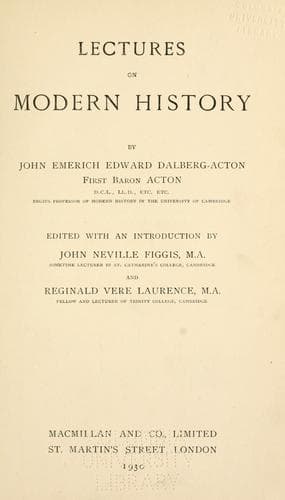
Lectures on Modern historyActon, John Emerich Edward Dalberg Acton, Baron
History
Lectures on Modern history
Acton, John Emerich Edward Dalberg Acton, Baron
History, Modern
Eugene, deserted by the English forces under Ormonde, was beaten by
Villars at Denain, and afterwards, by no fault of the English, at
Friedlingen. Then the emperor made his own peace at Rastadt. At
Utrecht, the Dutch secured a favourable tariff, the right of garrison
in a line of fortified towns, from Ghent to Namur, and the daring
Torcy had so thoroughly penetrated the weakness of England, in
consequence of party divisions, that he concluded a disastrous war by
negotiation. France retained her own territory, practically
undiminished, recovering Lille, and acquiring, for the younger branch
of the royal house, Spain and the Spanish colonies. It gained
infinitely more than either Holland or England. Marshal La Feuillade
asked Bolingbroke why he had let them off so easily. The answer was:
Because we were no longer afraid of you. Philip V retained all that
was legitimately Spanish, in Europe and America, excepting the two
fortresses conquered by England, Gibraltar and Port Mahon. He refused
to give up Corunna. But he renounced his claim in the succession to
his grandfathers crown. Bolingbroke betrayed the allies, and he
disgraced his country by the monopoly of the slave trade; but the
distribution was not unfair to the contracting parties, and the share
of England was not excessive. We acquired Newfoundland, Nova Scotia,
and the Hudson Bay territory, and, in addition to the asiento, the
right of trading in the possessions of the House of Bourbon--in fact,
the commerce of the world. And our revolutionary system, the
permanent exclusion of the Stuarts, received the sanction of Europe.
It was the condemnation of the principle of non-resistance, which had
carried the Tories to power, and the perpetuation of Whiggism.
Bolingbroke did not intend that the great achievement of his life
should serve the purpose of his enemies, and he gravitated towards the
Stuarts, the true representatives of the cause to which Sacheverell
had given renewed vitality. Harley had opened, through Berwick,
negotiations with St. Germains, and had thereby secured the help of
the Jacobite organisation. Bolingbroke went further. He believed
that the Elector of Hanover could not be prevented from coming in, but
that he would soon be driven out again. He said that he was too
unintelligent to understand and manage parties, too much accustomed to
have his own way to submit to govern under constitutional control. He
promised that King James would be restored. And the French concluded
peace at Utrecht in the belief that they were dealing with a Jacobite,
that their concession in regard to the crown of England amounted to
nothing, that, by yielding now, they would secure hereafter the
elevation of a dependent dynasty. Under that illusion they combined
with Bolingbroke to overreach themselves and to institute party
government, under the supremacy of the Whigs.
XVI
THE HANOVERIAN SETTLEMENT
Public-domain text, read in full here on John Shaqi.
Reviews
Reviews
No reviews yet
Be the first to share your thoughts on this work.
Elsewhere in the archive
Join the Discussion
Join the discussion
Sign in to leave a comment or review.
Sign InorCreate an account