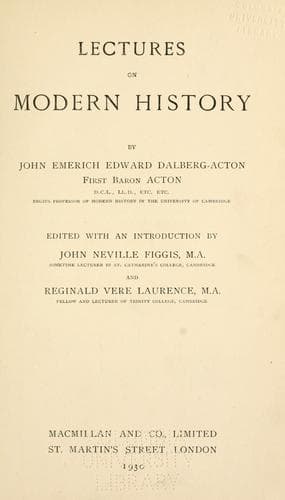
Lectures on Modern historyActon, John Emerich Edward Dalberg Acton, Baron
History
Lectures on Modern history
Acton, John Emerich Edward Dalberg Acton, Baron
History, Modern
THE FIRST thing is to consider by what steps a government came into
existence entirely different from that of England in the seventeenth
century, and unlike anything that had previously been known in Europe.
The old order terminates with the Bill of Rights and the Act of
Settlement. What followed is not a development of that Act, but in
contradiction to it. With the new dynasty there is a new departure.
And the change was not effected by statute, but by that force which
makes the law, and is above the law, the logic of facts and the
opinion of the nation. The essential innovations, the cabinet, the
premier, and government by party, are still without legislative
sanction. The Act of Settlement was speedily unsettled. It separated
the administration from the legislature by excluding placemen from the
House of Commons; and it prohibited the king from visiting his foreign
dominions without leave. And it required the king to be advised by
the Privy Council, thereby rejecting a united cabinet, the exclusive
organ of a party. Both William and, at that time, Marlborough
preferred that all the leading men should be united in the
administration. Before the Act of Settlement, came into operation,
during the reign of Anne, the idea of a united cabinet taken from the
same party had prevailed, and at last even Harley could not be
tolerated by the Jacobites. If Bolingbroke had not made it impossible
for George I to trust the loyalty of the Tories, the rising of 1715
would have been fatal to them. The new dynasty governed by the Whigs,
that is, by one party, and by a cabinet, not by the council. As the
king understood neither English nor English affairs, he very rarely
presided. The cabinet decided in his absence, and then reported.
Public-domain text, read in full here on John Shaqi.
Reviews
Reviews
No reviews yet
Be the first to share your thoughts on this work.
Elsewhere in the archive
Join the Discussion
Join the discussion
Sign in to leave a comment or review.
Sign InorCreate an account