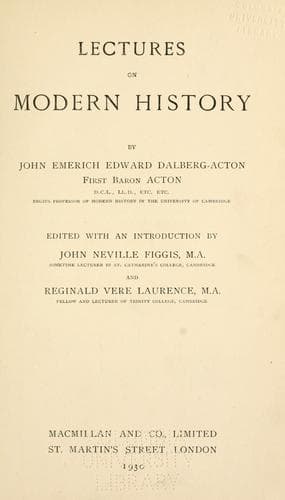
Lectures on Modern historyActon, John Emerich Edward Dalberg Acton, Baron
History
Lectures on Modern history
Acton, John Emerich Edward Dalberg Acton, Baron
History, Modern
It is necessary to see what manner of man he was. A branch of the
ancient Guelphic House reigned at Hanover, and had succeeded by
politic and constant effort in consolidating half a dozen territories
into one important principality. It was the most rising and
prosperous of the German Houses. It acquired the ninth electorate in
1692; and it was manifestly appropriate when it was designated for
the English succession, because the first elector, who had
accomplished the greatness of his family, had married the youngest
daughter of Elizabeth Stuart, the Princess Palatine, who in an evil
hour was Queen of Bohemia. The Electress Sophia was a Calvinist. Her
husband was a Lutheran. His predecessor, who died in 1678, had been a
convert to Catholicism. Hanover had been the centre of reunion, and
there were Lutheran divines there who, under the commanding influence
of Leibnitz, went further than Tract No. 90 in the direction of Rome.
With their easy comprehension and impartial appreciation of religious
systems, the Guelphs of Hanover were not representative Protestants.
Some misgivings arose in the mind of William III, and it was thought
that he looked with suspicious favour on the young Frederic William,
the man who afterwards drilled the battalions which Frederic the Great
led to victory. A Hanoverian statesman wrote, in alarm, that William
seemed to prefer the Prussian prince, because he was a Protestant, to
the Hanoverian, who was a Lutheran. The implication is that the
Lutherans offered less resistance to Catholicism. But the fact also
was that Sophia was a Stuart by the mother's side, and did not wish
too loudly to proclaim that she was not a legitimist. There was a
little ostensible hesitation; and the electress so managed that the
crown should seem to be forced upon her. It was part of this decorous
comedy that her son never learnt English--a circumstance of the utmost
value, afterwards, to England. The Electress Sophia was not perhaps a
very estimable, though a very intelligent princess. But she was
eighty-four when the crown came within reach, and she died of rage at
an unfriendly letter from Queen Anne, betraying her Jacobite
propensity.
Public-domain text, read in full here on John Shaqi.
Reviews
Reviews
No reviews yet
Be the first to share your thoughts on this work.
Elsewhere in the archive
Join the Discussion
Join the discussion
Sign in to leave a comment or review.
Sign InorCreate an account