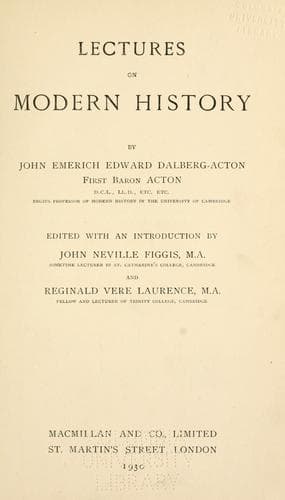
Lectures on Modern historyActon, John Emerich Edward Dalberg Acton, Baron
History
Lectures on Modern history
Acton, John Emerich Edward Dalberg Acton, Baron
History, Modern
#6 Il y a des savants qui raillent le sentiment religieux. Ils ne
savent pas que c'est a ce sentiment, et par son moyen, que la science
historique doit d'avoir pu sortir de l'enfence. . . . Depuis des
siecles les ames independantes discutaient les textes et les
traditions de l'eglise, quand les lettres n'avaient pas encore eu
l'idee de porter un regard critique sur les textes de l'antiquite
mondaine.--La France Protestante, ii. 17.
#7 In our own history, above all, every step in advance has been at
the same time a step backwards. It has often been shown how our
latest constitution is, amidst all external differences, essentially
the same as our earliest, how every struggle for right and freedom,
from the thirteenth century onwards, has simply been a struggle for
recovering something old.--FREEMAN, Historical Essays, iv., 253.
Nothing but a thorough knowledge of the social system, based upon a
regular study of its growth, can give us the power we require to
affect it.--HARRISON, Meaning of History, 19. Eine Sache wird nur
vollig auf dem Wege verstanden, wie sie selbst entsteht.--In dem
genetischen Verfahren sind the Grunde der Sache, auch die Grunde des
Erkennens.--TRENDELENBURG, Logische Untersuchungen, ii. 395, 388.
#8 Une telle liberte . . . n'a rien de commun avec le savant systeme
de garanties qui fait libres les peuples modernes.--BOUTMY, Annales
des Sciences Politiques, i. 157. Les trois grandes reformes qui ont
renouvele l'Angleterre, la liberte religieuse, la reforme
parlementaire; et la liberte economique, ont ete obtenues sous la
pression des organisations extra-constitutionnelles.-OSTROGORSKI,
Revue Historique, lii. 272.
#9 The question which is at the bottom of all constitutional
struggles, the question between the national will and the national
law.--GARDINER, Documents, xviii. Religion, considered simply as the
principle which balances the power of human opinion, which takes man
out of the grasp of custom and fashion, and teaches him to refer
himself to a higher tribunal, is an infinite aid to moral strength and
elevation.--CHANNING, Works, iv. 83. Je tiens que le passe ne suffit
jamais au present. Personne n'est plus dispose que moi a profiter de
ses lecons; mais en meme temps, je le demande, le present ne
fournit-il pas toujours les indications qui lui sont propres?--MOLE,
in FALLOUX, Etudes et Souvenirs, 130. Admirons la sagesse de nos
peres, et tachons de l'imiter, en faisant ce qui convient a notre
siecle.-GALIANI, Dialogues, 40
#10 Ceterum in legendis Historiis malim te ductum animi, quam anxias
leges sequi. Nullae stint, quae non magnas habeant utilitates; et
melius haerent, quae libenter legimus. In universum tamen, non
incipere ab antiquissimis, sod ab his, quae nostris temporibus
nostraeque notitiae propius cohaerent, ac paulatim deinde in remotiora
eniti, magis e re arbitror.-GROTIUS, Epistolae, 18.
Public-domain text, read in full here on John Shaqi.
Reviews
Reviews
No reviews yet
Be the first to share your thoughts on this work.
Join the Discussion
Join the discussion
Sign in to leave a comment or review.
Sign InorCreate an account