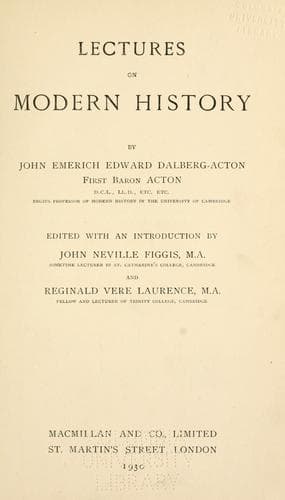
Lectures on Modern historyActon, John Emerich Edward Dalberg Acton, Baron
History
Lectures on Modern history
Acton, John Emerich Edward Dalberg Acton, Baron
History, Modern
His most dangerous enemy was the Prince of Wales; not the Stuart who
held his court in Lorraine, but his own eldest son. For George II
believed in the prisoner of Ahlden; believed that his mother had been
cruelly treated, wrongfully accused, and unjustly divorced, and was
therefore able to see his father by an exceedingly clear light. Thence
arose a bitter enmity between them, and that tendency to opposition in
the princes of Wales which became a family tradition and a salutary
factor in the Constitution.
George I found that, as long as he respected English institutions,
things went very well with him, and he made no attempt to overturn
them. The fear that a sovereign who was nominally absolute in one
place could never govern under a constitution in another proved to be
unnecessary. His interests, and those of his continental advisers,
were mainly continental. In political science he had long had the
ablest counsellor in Europe at his elbow, Leibnitz, the friend of the
electress. And although that great man did not enjoy unbroken favour,
it was not easy to be blind to the flood of light which he poured on
every subject. Leibnitz had been instrumental in securing the
succession, and he abounded in expositions of constitutional policy.
He professed himself so good a Whig that he attributed to that cause
his unpopularity with many people in England, especially at Cambridge,
and most of all at Trinity. He seems not to have known that his
rival, Newton, was as good a Whig as himself, and indeed a much better
one. It was characteristic of his mind ever to impute the broad
divisions of opinion among men to ignorance or incapacity to
understand each other. With a more scientific method, he thought that
many disputes could be settled, and many adversaries reconciled. For
many years it was his favourite occupation to show that there was no
real cause for a breach at the Reformation, and that people called
themselves Protestants not knowing what was really meant by Catholic.
He assured the Catholics that the Confession of Augsburg, rightly
understood, was sound Catholicism; and he assured the Lutherans that
there was nothing in the Council of Trent with which they were forced,
in consistency, to quarrel. With the same maxim, that men are
generally right in what they affirm, and wrong in what they deny, he
taught that Whig and Tory are alike necessary portions of truth, that
they complete each other, that they need each other, that a true
philosophy of politics includes the two. He also said that the past
is a law for the future, and that the will of Providence consecrates
those things which are permitted to succeed and to endure. This is
pure conservatism. The Whig seeks that which ought to be elsewhere
than in that which is. His standing purpose is to effect change, for
the past is essentially Tory.
Public-domain text, read in full here on John Shaqi.
Reviews
Reviews
No reviews yet
Be the first to share your thoughts on this work.
Elsewhere in the archive
Join the Discussion
Join the discussion
Sign in to leave a comment or review.
Sign InorCreate an account