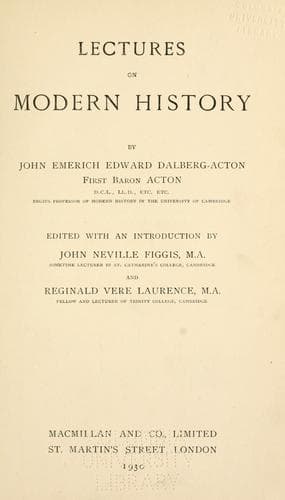
Lectures on Modern historyActon, John Emerich Edward Dalberg Acton, Baron
History
Lectures on Modern history
Acton, John Emerich Edward Dalberg Acton, Baron
History, Modern
The influence of the most enlightened German on the new German dynasty
was not favourable to party government, and would have combined better
with the system of William III. They consulted an enlightened
Englishman, and Lord Cowper drew up an important political paper,
showing that the king ought to depend on the Whigs. Moreover,
Bolingbroke, at the last moment, by his Stuart intrigue, compelled
George I to come in as the nominee of a party. To Bolingbroke's
intrigues the House of Hanover owed that which it most needed, the
prestige of victory. He had found comfort in the reflection that,
although it might be impossible to prevent the heralds from
proclaiming the new monarchy, the new monarch would soon make himself
odious, and would be more easy to expel than to exclude. The mass of
the people was Tory, and the majority of Tories were Jacobites. There
was the assured co-operation of the sects discontented with the Union,
and a part of the very small army would be held fast by the sullen
anger of the Irish.
Lewis XIV, weary and inert, would not risk another war; but if he saw
his opportunity to interfere, he was not likely to neglect it. The
Pretender would be advised by his brother, Berwick, the victor of
Almanza. The insurgent forces would be led by the Duke of Ormonde,
who had succeeded Marlborough as commander-in-chief. Marlborough
himself had advanced money for the Jacobite rising, and was so much
suspected by the ministers that they would not let him take the
command.
The hopefulness of the situation darkened somewhat before the time for
action arrived. Lewis XIV died, and the Regent, having Philip of
Spain for a rival, required the good-will of England. Two miscreants,
to whom James had offered L20,000 if they would shoot the king and the
Prince of Wales, failed to earn their reward. The arrest of a leading
Jacobite, Sir William Wyndham, so scared his partisans, that Ormonde,
having sailed into Torbay, returned to St. Malo without landing. The
Highlanders rose, but there was no Dundee and no Montrose to make them
superior to regular troops. They fought with doubtful fortune at
Sheriffmuir, while the Borderers, finding no support in Lancashire,
surrendered at Preston. When James Stuart landed in Aberdeenshire,
the struggle was over. Cadogan was approaching at the head of the
Dutch auxiliaries, and the Pretender escaped by a back door from his
own men, and made his way to Gravelines. He had proved unequal to the
occasion, and was not gifted with political understanding. But he had
been instructed by Fenelon, and had learnt from him the doctrine of
toleration.
Public-domain text, read in full here on John Shaqi.
Reviews
Reviews
No reviews yet
Be the first to share your thoughts on this work.
Elsewhere in the archive
Join the Discussion
Join the discussion
Sign in to leave a comment or review.
Sign InorCreate an account