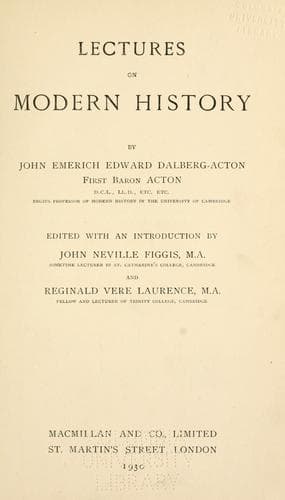
Lectures on Modern historyActon, John Emerich Edward Dalberg Acton, Baron
History
Lectures on Modern history
Acton, John Emerich Edward Dalberg Acton, Baron
History, Modern
On this state of feeling the government introduced septennial
parliaments. Under the Triennial Act a general election would have
fallen due in 1717, too soon for safety after the Jacobite rising.
Opinion in the country had not been impressed by recent events, by the
utter weakness of the rebels, the overwhelming success of the
government, the significant menace of the dying leader, so deeply as
the House of Commons. The new establishment would be in peril with
the constituencies, but safe with their representatives. This was so
certain that the philosophic arguments, for legislative independence
and for popular control, were superfluous. The victors secured their
victory and perpetuated their power by extending their mandate from
three years to seven. The measure strengthened the House of Commons,
and prepared the long reign of the Whigs. The funds rose, and the
king took advantage of the improved situation to spend some months in
Hanover. There he had greater scope to devote himself to foreign
affairs, and to bring the Englishmen who attended him under the
influence of experienced foreigners. Thus, while the Tories were
prostrate and the Whigs supreme, a schism arose between the ministers
at Hanover and the ministers at home. Walpole and Townshend went out
of office; Stanhope and Sunderland formed a new administration, which
the South Sea Bubble overthrew. A great question of constitutional
principle opened between them and their former colleagues. The enmity
between the king and the Prince of Wales made it probable that the
ministers who had the confidence of the father would be dismissed on
his son's accession. George II, to carry out his purpose, would be
obliged to swamp the House of Lords with new peers. To prevent this,
it was proposed to limit the power of creation and to fix a maximum
number. As the Septennial Act had increased the power of the commons,
the Peerage Bill would, in their turn, have increased the power of the
peers, against the crown on one hand, against the commons on the
other. The Whigs were not prepared to diminish the House of Commons,
and not yet afraid that it would become too powerful, exposed as it
was to corruption, and elected, on a narrow franchise, by an
uneducated constituency. Burnet, the typical Whig, had protested
against such limitations as should quite change the form of our
government, and render the crown titular and precarious.
Public-domain text, read in full here on John Shaqi.
Reviews
Reviews
No reviews yet
Be the first to share your thoughts on this work.
Elsewhere in the archive
Join the Discussion
Join the discussion
Sign in to leave a comment or review.
Sign InorCreate an account