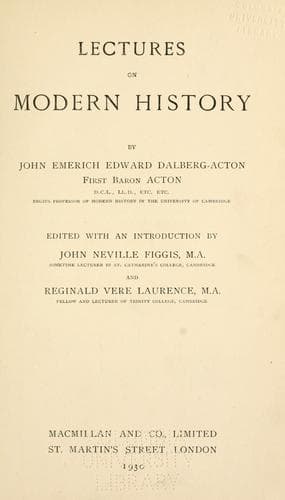
Lectures on Modern historyActon, John Emerich Edward Dalberg Acton, Baron
History
Lectures on Modern history
Acton, John Emerich Edward Dalberg Acton, Baron
History, Modern
Walpole defeated the Bill. It deprived government of one great means
of influence, by abolishing the hope of a peerage. He was not
prepared to sacrifice a legitimate species of patronage. He came
back, thereupon, to office, but not to a principal office; and he was
not a member of the Cabinet when the South Sea Company undertook to
reduce the National Debt. They offered only eight and a half years'
purchase; but the spirit of speculation was strong, and these bad
terms were widely accepted. The shares of the Company rose from 130
to 1000. As there was so much capital seeking investment, rival
enterprises were started, and were opposed by the South Sea Company.
Their ruin destroyed its credit; and after large sums had been won,
large sums were lost. Some had been impoverished, others enriched.
The country had not suffered, but the ministry fell. Walpole
inherited their power. The ground was cleared for his long
administration. It lasted so long that he did more than any other man
to establish the new system of government. He was more zealous to
retain his power than to make heroic use of it, and was a good
administrator but an indifferent legislator. In his time those things
were best which were done outside of parliament. Walpole made it his
business to yield to public opinion, and did it consistently in the
three critical moments of his career--in Wood's Halfpence, in the
Excise, and in the Spanish war. The same problem presented itself to
a greater man in the present century, and was decided on the opposite
principle. Guizot was himself persuaded that a measure of
parliamentary reform was inevitable, since the opinion of the country
was in its favour. But the opinion of parliament was against it, and
he preferred to fall, together with the monarchy, in obedience to
parliament, rather than to triumph by public opinion.
Walpole gave way in the affair of the Halfpence, that he might not
alienate those through whom he governed Ireland. The coins were good.
They were to contain twice the value of metal with which we are
satisfied, and it was never shown that they did not. The gains of the
contractor were exhorbitant. He was able to pay a heavy fee to the
Duchess of Kendal; and when the contract was revoked, he obtained an
excessive compensation. His Halfpence are historic because Swift, in
raising a tempest over the Irish grievance, employed the language of
revolution and national patriotism, as it had never been heard.
Again, the Excise Bill would have saved many hundreds of thousands of
pounds to the State, when a hundred thousand was more than a million
is now; but Walpole, in spite of his majority, yielded to the clamour
outside. And he did the same thing in regard to the Spanish war, the
last great crisis he encountered.
Public-domain text, read in full here on John Shaqi.
Reviews
Reviews
No reviews yet
Be the first to share your thoughts on this work.
Elsewhere in the archive
Join the Discussion
Join the discussion
Sign in to leave a comment or review.
Sign InorCreate an account