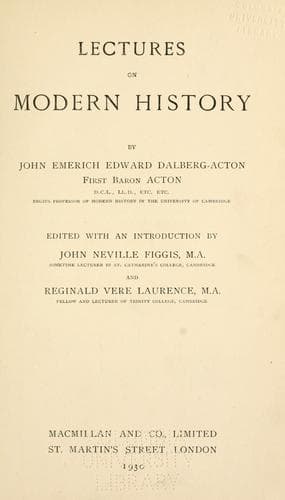
Lectures on Modern historyActon, John Emerich Edward Dalberg Acton, Baron
History
Lectures on Modern history
Acton, John Emerich Edward Dalberg Acton, Baron
History, Modern
The new spirit began to reign when the young Tsar Peter triumphed over
family intrigues that were supported by the party of reaction. He was
uneducated, unmannerly, uncivilised; but he had a clear notion of that
which his people required, and the energy and force of character to
achieve it. As there were no roads in Russia, and not much material
for making them, the waterway was the easy and natural line to follow.
The Russian rivers flowed to the Caspian and the Euxine, and invited
to the conquest of Persia and Central Asia, or to the deliverance of
the Slavonic and Greek brethren from the Turk. Peter was not carried
away by either prospect. He did indeed send a fleet down the Volga,
and another down the Don. He conquered the Persian coast of the
Caspian, but resisted the temptation of pushing his arms to the Indian
Ocean. He was repeatedly at war with the Turk; but he contented
himself with a humble measure of success.
Poland, for reasons of race and religion, was the national enemy; and
from the death of Sobieski in 1696 there were symptoms that it was
likely to break up. The next king, Augustus of Saxony, in 1702,
proposed the partition of the Polish dominions. His agent, Patkul,
renewed the idea at Berlin in 1704, and Austria did the same in 1712.
At the height of his military success, in 1710, Peter entertained the
idea, only to dismiss it. He preferred to wait. Poland would be
convenient as a helpless neighbour, covering his frontier on a
dangerous side; and its constitution prevented it from becoming
formidable. He was content to make sure that the feeble government
should never undergo reform. He resolutely fixed his thoughts in
another direction, and chose, not the easiest, but the most difficult
line of attack.
Tartars, or Persians, or Zaporogue Cossacks supplied no new element
that could be of service to his people. The Russians had issued from
the long subjection to the Golden Horde, indigent, ignorant,
prejudiced, dishonest and false. A mighty future lay before them, but
they were unfit for such a destiny. The civilising influences they
required could come only from contact with superior races. From them
they must import the goods, they must import the men, that were needed
to raise them, in the arts of peace and war, to a level with others.
The route for both species of commerce was by sea. But Russia touched
the sea only in the North, where it is closed by ice. The way to the
countries that were most advanced, intellectually and socially, to
France and England, especially to Holland and the empire behind it,
was by the Baltic.
Public-domain text, read in full here on John Shaqi.
Reviews
Reviews
No reviews yet
Be the first to share your thoughts on this work.
Elsewhere in the archive
Join the Discussion
Join the discussion
Sign in to leave a comment or review.
Sign InorCreate an account