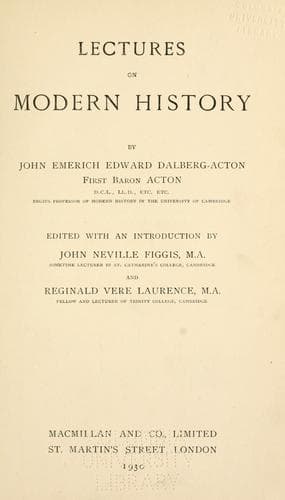
Lectures on Modern historyActon, John Emerich Edward Dalberg Acton, Baron
History
Lectures on Modern history
Acton, John Emerich Edward Dalberg Acton, Baron
History, Modern
The Muscovite empire extended from the frontiers of Poland to the
farthest extremity of China. In numbers and in extent it was the
first of Christian Powers. But it played no part in the concert or
the conflict of Europe, and its existence was almost unnoticed and
unfelt. The people were too backward in the scale of wealth or
knowledge or civilisation to obtain influence even on their
neighbours. Potentially the most formidable force on earth,
practically they were forgotten and unknown. In a single reign, by
the action of one man, Russia passed from lethargy and obscurity to a
dominant position among the nations.
The first need was intercourse with the world--intercourse of trade
for its material progress, intercourse of ideas for its civilisation.
The problem was too obvious to escape the earlier Romanoffs. They
were a clerical dynasty, closely associated with the Church, and
allowing to the Patriarch a position very near the throne. In
politics they were inefficient and unsuccessful; but their Church
policy was charged with far-reaching consequences. In that, they were
superior to the people about them, and they introduced certain
moderate reforms, literary rather than dogmatic, in the externals of
ritual, and in the liturgical books. An illiterate clergy had allowed
abuses to take root, and were excessively intolerant of change. A
schism arose between the established church with its rectified texts
and improved ceremonial, and the large minority who rejected them.
Everybody knows Newman's story of the ancient priest who fell into the
habit, at mass, of saying, "quod ore mumpsimus" instead of "quod ore
sumpsimus," and, when admonished of his error, refused to exchange old
"mumpsimus" for new "sumpsimus." Although "mumpsimus" is the very
motto for the Russian schismatics, and although ignorance and
superstition were the root of the matter, they combined with a dread
of arbitrary change by an arbitrary power, and supplied a basis for
resistance to Erastianism and the fusion of Church and State. This
was the heart of the opposition to the later reforms, to which the
Church in general yielded reluctantly, and the sectaries not at all,
choosing death, and even suicide by fire, to compromise. The
reforming government was driven into persecution by the fanaticism of
these men.
Public-domain text, read in full here on John Shaqi.
Reviews
Reviews
No reviews yet
Be the first to share your thoughts on this work.
Elsewhere in the archive
Join the Discussion
Join the discussion
Sign in to leave a comment or review.
Sign InorCreate an account