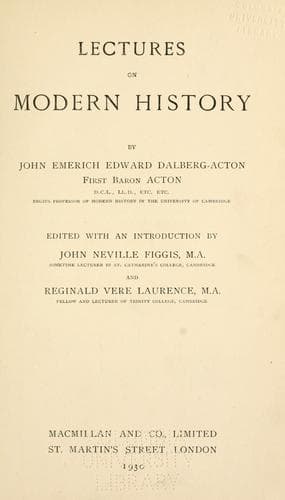
Lectures on Modern historyActon, John Emerich Edward Dalberg Acton, Baron
History
Lectures on Modern history
Acton, John Emerich Edward Dalberg Acton, Baron
History, Modern
The concentration was such, the destruction of resisting forces was so
complete, that the machine worked well in the hands of women. For
almost the whole of the seventy years after Peter's death, Russia was
governed by empresses. The last of them, Catharine II, was one of the
ablest and most successful rulers in modern times. For the machine
which Peter created was strong enough to endure. It still exists as
he made it, an amalgam of power and servility, never leading, but
often supplying the deciding force in the history of the world. It
was the empire of Peter the Great that destroyed the empire of
Napoleon.
Such a Power, limited by feeble neighbours, would have been a danger
to the whole of Europe, but that another great Power, founded in the
same generation, became a bulwark against a menacing expansion. The
rise of Prussia preserved the Continent from being submerged. This
new phase of northern monarchy was very unlike that which we have just
considered. Prussia, like Russia, was a military Power, living on the
hope of expansion. But it was infinitely inferior, as to extent and
population. It was not a giant but an athlete; and its future
depended, not on the intrusion of foreign elements, but on its own
development and practical organisation. Nature had done nothing to
promise greatness. The country was open and arid, and the inhabitants
were hard, unimaginative, and poor. Religion had less power over them
than over any other part of Germany. To this day the sky-line of
Berlin is more unbroken by church towers than that of almost any other
city. Neither their situation on the map of Europe nor hereditary
endowment fitted the Prussians for empire. It was the work of the
dynasty that a country which was less than Scotland, and was protected
by no barrier of land or water, became greater than France.
The Prussian people, by which I mean the people of Brandenburg and its
vicinity, were conscious that Nature had not favoured them
excessively, and that they could prosper only by the action of their
government. No people were more submissive, or more ready to suffer,
for the sake of the State. And none have gone farther in asserting
its omnipotence, or in abdicating in its hands. They had no silver
streak, no natural barriers. As a consequence of the Reformation the
dominions of the Teutonic knights were joined in personal union under
the same Hohenzollerns who reigned on the Oder and the Elbe. One was
part of the empire, the other was enclosed in Poland, and they were
separated by Polish territory. They did not help each other, and each
was a source of danger for the other. They could only hope to exist
by becoming stronger. That has been, for two centuries and a half, a
fixed tradition at Berlin with the rulers and the people. They could
not help being aggressive, and they worshipped the authority that
could make them successful aggressors.
Public-domain text, read in full here on John Shaqi.
Reviews
Reviews
No reviews yet
Be the first to share your thoughts on this work.
Elsewhere in the archive
Join the Discussion
Join the discussion
Sign in to leave a comment or review.
Sign InorCreate an account