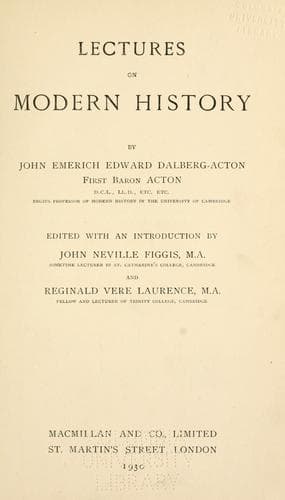
Lectures on Modern historyActon, John Emerich Edward Dalberg Acton, Baron
History
Lectures on Modern history
Acton, John Emerich Edward Dalberg Acton, Baron
History, Modern
The dynasty entered into the spirit of the problem from 1640.
One-half of the electors and kings since then have struggled intensely
for the increase of their power. And they built up their state in
spite of the other half, who had no enterprise or masterful energy.
But before the accession of the great elector, in 1640, Brandenburg
had taken a line of its own in the question of religion which was
eminently favourable to territorial increase. It was more tolerant
than other portions of the empire. The elector was one of the last of
the German princes to join the Reformation. And Saxony retained the
pre-eminence among the Protestants. Early in the seventeenth century
the reigning family became Calvinists. The country was Lutheran. The
position was unfavourable to the exercise of what was called the right
of Reformation, the right of enforcing conformity under pain of exile;
and, between the Calvinist at the head and the Lutherans in every
other office, the Catholics were able to exist. In some provinces,
though not in all, they were definitely tolerated. The great elector
made every effort to attract the fugitive Huguenots. Agents were sent
out to show them the way, and to help them with funds. Whole
districts were peopled by them, and about twenty thousand of them
settled in Berlin and other towns. Like Peter the Great, the great
elector derived his notion of better things from Holland, and he
encouraged Dutch artisans to settle. His dominions were scattered and
unlike. He introduced a system of government that was the same for
all, and was above local or social influences. The estates lost their
ancient authority, and one supreme will governed everything, through a
body of trained administrators such as up to that time existed nowhere
else.
The next elector obtained the royal crown. Prince Eugene said that
the emperor's ministers, who had advised the grant, deserved to be
hanged. But in fact they were not less prescient than he, for they
warned Leopold that Prussia would deprive his family of the empire.
The King of Prussia became the head of the Protestant interest in
Germany. That prerogative had been forfeited by the Elector of Saxony
when he received the crown of Poland and became a Catholic. Rome
alone protested against the Protestant king, and spoke only of a
margrave of Brandenburg until after the death of Frederic II. All the
Catholic Powers acknowledged the new title and disregarded the
protest. For the first time there was a kingdom within the empire, a
kingdom, moreover, which was Protestant. It was a step towards the
break-up of that irrational body.
Public-domain text, read in full here on John Shaqi.
Reviews
Reviews
No reviews yet
Be the first to share your thoughts on this work.
Elsewhere in the archive
Join the Discussion
Join the discussion
Sign in to leave a comment or review.
Sign InorCreate an account