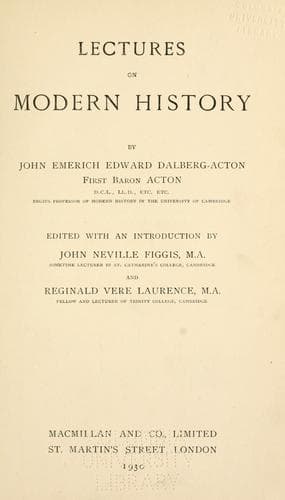
Lectures on Modern historyActon, John Emerich Edward Dalberg Acton, Baron
History
Lectures on Modern history
Acton, John Emerich Edward Dalberg Acton, Baron
History, Modern
In Prussia, there was no repose, no leisure, but simply the tension of
a tiger crouching for a spring. The king, who had devoted his life to
creating the greatest army in Europe, never attempted to employ it,
and left it a thunderbolt in the hands of his son. The crown prince
was a musician and a versifier, with a taste for clever men, but also
for cleverish men, an epicurean student, with much loose knowledge,
literary rather than scientific, and an inaccurate acquaintance with
French and Latin. To Bayle, Locke, Voltaire in his first manner, he
owed an abundance of borrowed ideas, conventionally rational; but to
the rising literature; of his own country, which ruled the world
before he died, he did not attend. Hardened by his father's
heartless severity he learnt to live without sympathy, to despise
mankind, to rely on himself. He was the author of a commonplace
treatise against Machiavelli, partly founded on Montesquieu's Grandeur
et Decadence. This unamiable youth, with the aspirations and the
vanity of a minor poet, was the most consummate practical genius that,
in modern times, has inherited a throne.
In the same year, 1740, in which Frederic II succeeded his father, the
Emperor Charles VI died, leaving his hereditary dominions to his
daughter Maria Theresa, wife of the Grand Duke of Tuscany, of the
House of Lorraine. By an instrument called the Pragmatic Sanction,
which was the subject of protracted negotiations, the Powers had
agreed to acknowledge her right. She was & sensible and reasonable
woman, much the best that had ever reigned; but she was without
culture or superior talent, and he husband was not able to supply the
deficiency. Frederic at once made himself master of Silesia. There
were certain territorial claims. The succession was about to be
disputed, and a scramble might be expected. The death of the Russian
empress, Anne, made it improbable that Austria would be protected on
that side. Frederic was ambitious, and he was strong enough to
gratify his ambition. No accepted code regulated the relations
between States. It could not be exactly the same as that between men;
and in what respect it differed was not determined. States were
absolute, and acknowledged no law over them. Grave and disinterested
men would have admitted that that may be done for the State which
could not be done for the individual; that robbery was not robbery,
that murder was not murder, if it was committed in the public
interest. There might be a want of generosity, a want of delicacy
about it; but if conquest by unprovoked attack was a crime, in the
same sense or the same degree as poisoning a man to obtain his
property, history must undergo a fundamental revision, and all respect
for sovereign authority must be banished from the world. How far that
revision has been accomplished or that respect has departed, at the
present day, may be hard to say. At that time, Frederic was much more
Public-domain text, read in full here on John Shaqi.
Reviews
Reviews
No reviews yet
Be the first to share your thoughts on this work.
Elsewhere in the archive
Join the Discussion
Join the discussion
Sign in to leave a comment or review.
Sign InorCreate an account