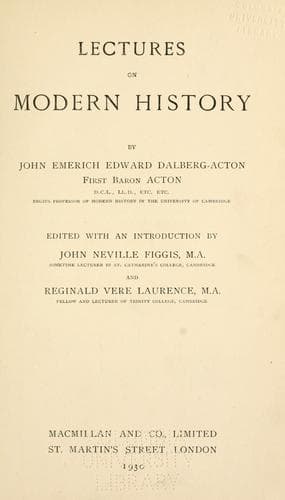
Lectures on Modern historyActon, John Emerich Edward Dalberg Acton, Baron
History
Lectures on Modern history
Acton, John Emerich Edward Dalberg Acton, Baron
History, Modern
He thus created the force which began what Napoleon
completed, the dissolution of the Holy Roman Empire. For that which
the father stored, the son expended; and I hope in the next lecture to
tell you how he did it.
He so eclipsed Frederic William that the latter became an obscure
memory, and was spoken of with contempt and disgust by his own people.
Carlyle discovered in him his own ideal, the strong man, and set him
on his legs. And when the army which he created, which had been
remodelled by Frederic, Scharnhorst, Roon, and Moltke, became the
greatest of all armies, Germany remembered its founder and was
grateful for his militarism.
They have made their choice, as we must do. Those who remember with
honour men like Hampden and Washington, regard with a corresponding
aversion Peter the Great and Frederic William I. But without the
first Europe might be French, and without the other it might be
Russian. That which arose in Northern Europe about the time of our
revolution settlement was a new form of practical absolutism.
Theological monarchy had done its time, and was now followed by
military monarchy. Church and State had oppressed mankind together;
henceforth the State oppressed for its own sake. And this was the
genuine idea which came in with the Renaissance, according to which
the State alone governs, and all other things obey. Reformation and
Counter-Reformation had pushed religion to the front: but after two
centuries the original theory, that government must be undivided and
uncontrolled, began to prevail. It is a new type, not to be
confounded with that of Henry VIII, Philip II, or Lewis XIV, and
better adapted to a more rational and economic age. Government so
understood is the intellectual guide of the nation, the promoter of
wealth, the teacher of knowledge, the guardian of morality, the
mainspring of the ascending movement of man. That is the tremendous
power, supported by millions of bayonets, which grew up in the days of
which I have been speaking at Petersburg, and was developed, by much
abler minds, chiefly at Berlin; and it is the greatest danger that
remains to be encountered by the Anglo-Saxon race.
XVIII
FREDERIC THE GREAT
THE PEACE of Utrecht was followed by a period of languor and
depression. Spain and Sweden asserted themselves unsuccessfully;
whilst England under Walpole, France under Fleury, Austria under the
ceremonious majesty of Charles VI, were inactive and pacific; The
generation lacked initiative, and was not rich in eminent men.
Public-domain text, read in full here on John Shaqi.
Reviews
Reviews
No reviews yet
Be the first to share your thoughts on this work.
Elsewhere in the archive
Join the Discussion
Join the discussion
Sign in to leave a comment or review.
Sign InorCreate an account