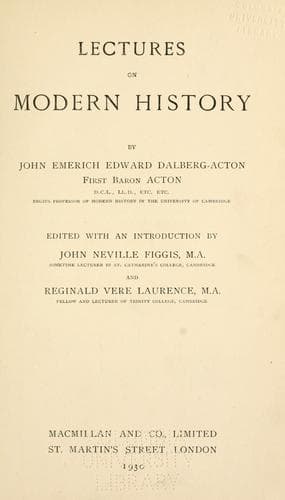
Lectures on Modern historyActon, John Emerich Edward Dalberg Acton, Baron
History
Lectures on Modern history
Acton, John Emerich Edward Dalberg Acton, Baron
History, Modern
Meanwhile Spain went to war with England, and the government began to
treat apart from Frederic. Newcastle would have renewed the subsidy,
but Bute refused, and Newcastle thereupon resigned, while Bute
concluded peace. Frederic, quite unable to continue active
operations, retained Silesia, but gave up his conquest, Saxony.
Therefore, at the price of immense suffering to his people, he emerged
from the unequal contest victorious and successful.
William III, Lewis XIV, Peter of Russia, had been great and able
sovereigns; but none had left on the world such an impression of his
genius. When Frederic appeared at the Te Deum at Charlottenburg in
all his glory, he broke down utterly and burst into tears. He had
been the victor, but it was England that carried away the prize. He
had acquired in his campaigns immeasurable authority and renown, but
his people had been decimated and impoverished, and he had gained no
accession of territory.
In the first years of peace that followed, it appeared that there was
a neighbouring country in which that deficiency might be repaired, and
the disappointing issue of the war might be made good by the art of
the statesman. The republic of Poland covered an enormous territory,
but was the most backward of the civilised nations. It was governed,
socially and politically, by the aristocratic class, and it was their
prerogative that any minority, or even a single noble, might exert the
right of veto on the proceedings of the Diet. The political
conditions were those of the eleventh century. The government was the
weakest in Europe. The Poles had been the earliest people to
establish religious toleration; but they had succumbed to the
Counter-Reformation, and they still refused liberty of conscience to
the Dissidents, mainly of the Greek Church. It was the plain policy
of Russia to maintain the grievance and the occasion for intervention,
and to frustrate every attempt of intelligent Poles to reform their
constitution and create a regular government.
Public-domain text, read in full here on John Shaqi.
Reviews
Reviews
No reviews yet
Be the first to share your thoughts on this work.
Elsewhere in the archive
Join the Discussion
Join the discussion
Sign in to leave a comment or review.
Sign InorCreate an account