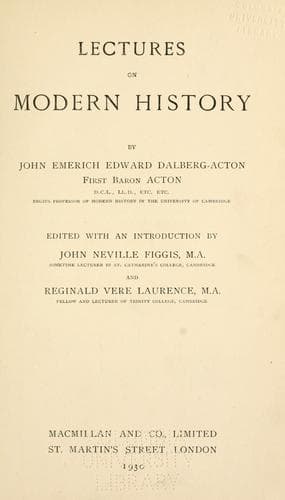
Lectures on Modern historyActon, John Emerich Edward Dalberg Acton, Baron
History
Lectures on Modern history
Acton, John Emerich Edward Dalberg Acton, Baron
History, Modern
In the reign of Catharine in Russia, and of her admirer Stanislas
Poniatowski in Poland, the republic became a Russian dependency. The
empress desired that this convenient situation should continue, and
esteemed that a partition would be injurious to her interests. From
the same point of view it appeared desirable to Austria and Prussia.
Poland, undivided as it was, was useless to anybody but Catharine.
Poland divided among friends would strengthen each of them at the
expense of Catharine. What they succeeded in appropriating would be
so much taken from the sphere of Russian power. The Russian empress
endeavoured to turn their thoughts elsewhere. She pointed to Turkey,
which was a dreadful blot on the map of Christendom, and proposed that
Austria should rectify its frontier on that side. But Turkey could
defend itself, and could not be subjected to spoliation without a
struggle, which Austria would have to carry on. That was a wretched
bargain compared with Poland, which must yield if the three Powers
showed their teeth. And Turkey could be of no use to Frederic the
Great. Therefore Kaunitz proposed that he should give back Silesia,
and compensate himself richly out of Polish territory, where Austria
also had some local claims to enforce.
Frederic was ready to annex part of Poland, but he saw no reason for
giving up anything that he possessed. If Austria wished to enlarge
her boundaries, Poland was extensive enough to satisfy her demands as
well as his own. There would be no difficulty, no obstacle on the
spot, no resistance of European opinion. England had already proposed
the Polish solution of territorial controversy. In France there would
be some genuine or affected displeasure. But Poland was a Catholic
country, much influenced by prelates. The men who guided French
thought would be easily consoled for its disappearance from the
political stage. It was not modern enough to interest them, and its
treatment of the Dissidents was a glaring offence. Therefore,
although Catharine annexed as much as both the others together, the
partition was accomplished in opposition to her real policy. About
one-third of Poland was thus taken. The reckoning proved correct.
Europe remained unmoved. By a series of treaties it had condoned the
seizure of Silesia. It was too late to complain of the dismemberment
of Poland. The work was completed, under very different conditions,
twenty years later. It was overthrown by Napoleon; but, as he was
without a Polish policy, and was disgusted by the obtrusive Liberalism
of the Poles in his time, it was revived and sanctioned by the wisdom
of united Europe at the Congress of Vienna.
Public-domain text, read in full here on John Shaqi.
Reviews
Reviews
No reviews yet
Be the first to share your thoughts on this work.
Elsewhere in the archive
Join the Discussion
Join the discussion
Sign in to leave a comment or review.
Sign InorCreate an account